9 Best Miter Saw Blades (October 2026)
The best miter saw blades include the Freud LU91M010 10-Inch 60-Tooth Miter Saw Blade for controlled crosscuts, the DeWalt DWA11280 12-Inch 80-Tooth Miter Saw Blade for 12-inch finish work, and the Diablo D1080X 10-Inch 80-Tooth Miter Saw Blade for fine woodworking.
On this page (10 sections)
- Which miter saw blade suits each kind of cut?
- How do you match a blade to your miter saw?
- How do tooth count and tooth shape affect the cut?
- Does a thin kerf blade cut better?
- How do you choose a blade for trim and baseboards?
- What setup helps a blade make a clean cut?
- What common blade mistakes should you avoid?
- How should you care for a miter saw blade?
- How do you choose between 10-inch and 12-inch blades?
- Which best miter saw blade should you choose?
The Freud LU91M010 10-Inch 60-Tooth Miter Saw Blade is the best miter saw blade for most controlled crosscuts on a compatible saw. If your saw takes an 80-tooth blade, the Diablo D1080X and Makita A-93681 suit finer woodworking and trim.
Blade fit comes first: diameter, arbor and saw-maker limits must all match. A 12 in blade does not fit a 10 in saw, and two blades with the same diameter can still have different arbor requirements.
For help choosing a saw before you choose an accessory, compare compound miter saw types and sizes. If you're deciding between a sliding and fixed saw, read what a sliding compound miter saw does.
Our picks at a glance
-
1
 Best for controlled crosscuts
Freud LU91M010 10-Inch 60-Tooth Miter Saw Blade
8.9/10 our score
See it on Amazon -
2
 Best for 12-inch finish work
DeWalt DWA11280 12-Inch 80-Tooth Miter Saw Blade
8.7/10 our score
See it on Amazon -
3
 Best for fine woodworking
Diablo D1080X 10-Inch 80-Tooth Miter Saw Blade
8.6/10 our score
See it on Amazon
- 4
 Check it
Makita A-93681 10-Inch 80-Tooth Miter Saw Blade
Best for polished wood edges - 5
 Check it
Diablo 12-Inch 80-Tooth Hi-ATB Miter Saw Blade
Best for hardwood crosscuts - 6
 Check it
Makita B-66977 10-Inch 80-Tooth Miter Saw Blade
Best for reduced motor drag - 7
 Check it
Freud LU88R010 10-Inch Thin Kerf Crosscut Blade
Best for faster feeding - 8
 Check it
Bosch DCB1280 12-Inch 80-Tooth Saw Blade
Best for extra-fine cuts - 9
 Check it
WEN BL1060 10-Inch 60-Tooth Saw Blade
Best for general woodcuts
Which miter saw blade suits each kind of cut?
The best miter saw blade depends on the finish you need, the material you cut and the blade your saw accepts. More teeth can support a finer cut, while a lower tooth count can suit faster general cutting.
These picks cover 10 in and 12 in blades, 60- and 80-tooth designs, and a range of tooth shapes and kerfs. Use the comparison table to narrow your options, then check the exact requirements in your saw manual.
| Product | Best for | Diameter | Teeth | Arbor | Our score |
|---|---|---|---|---|---|
| Freud LU91M010 10-Inch 60-Tooth Miter Saw Blade | controlled crosscuts | 10 in | 60 ATB | 5/8 in | 8.9 |
| DeWalt DWA11280 12-Inch 80-Tooth Miter Saw Blade | 12-inch finish work | 12 in | 80 | 8.7 | |
| Diablo D1080X 10-Inch 80-Tooth Miter Saw Blade | fine woodworking | 10 in | 80 ATB | 5/8 in | 8.6 |
| Makita A-93681 10-Inch 80-Tooth Miter Saw Blade | polished wood edges | 10 in | 80 ATAF | 8.5 | |
| Diablo 12-Inch 80-Tooth Hi-ATB Miter Saw Blade | hardwood crosscuts | 12 in | 80 Hi-ATB | 1 in | 8.4 |
| Makita B-66977 10-Inch 80-Tooth Miter Saw Blade | reduced motor drag | 10 in | 80 ATAFR | 8.2 | |
| Freud LU88R010 10-Inch Thin Kerf Crosscut Blade | faster feeding | 10 in | 60 ATB | 5/8 in | 8.1 |
| Bosch DCB1280 12-Inch 80-Tooth Saw Blade | extra-fine cuts | 12 in | 80 | 8.0 | |
| WEN BL1060 10-Inch 60-Tooth Saw Blade | general woodcuts | 10 in | 60 carbide-tipped | 5/8 in | 7.8 |
Best miter saw blade for controlled crosscuts: Freud LU91M010
Freud LU91M010 10-Inch 60-Tooth Miter Saw Blade: Best for controlled crosscuts
- 10 in diameter
- 60 ATB teeth
- 5/8 in arbor
- Negative 5-degree hook angle
- 0.090 in thin kerf
The negative hook angle helps limit climbing on a sliding compound saw, while the thin kerf needs less power. Check that your saw accepts a 10 in blade with a 5/8 in arbor.
Pros
- Negative hook angle
- Thin kerf
- Silver Ice coating resists pitch buildup and corrosion
Cons
- 60 teeth may leave a less fine finish than an 80-tooth option
The Freud LU91M010 is the top pick for crosscuts when controlled feeding matters. Its negative 5-degree hook angle is designed to reduce climbing, and its thin kerf needs less power than a wider cut.
The 60-tooth ATB pattern suits crosscutting, while the Silver Ice coating resists corrosion and pitch buildup. Freud describes it for sliding compound miter saws, so check your saw manual before fitting it to another type.
Choose this blade for controlled feeding and a thinner kerf, especially when your saw has limited power. Skip it if your main goal is the finest possible cut from a high-tooth-count blade, or if your saw does not accept its diameter and arbor.
Set the work flat against the table and fence, then hold it securely using the saw's approved method. Bring the blade through the work at a steady pace, without forcing the cut.
Best miter saw blade for 12-inch finish work: DeWalt DWA11280
DeWalt DWA11280 12-Inch 80-Tooth Miter Saw Blade: Best for 12-inch finish work
- 12 in diameter
- 80 teeth
- Optimized tooth geometry
- Patented body slots
- Carbide-tipped teeth
This 12 in blade has 80 teeth and a tooth geometry designed for accuracy. Choose it only if your saw is built for a 12 in blade and its arbor fits.
Pros
- 80 teeth for fine cutting
- Body slots are designed for low vibration
- Carbide teeth
Cons
- 12 in diameter rules it out for 10 in saws
The DeWalt DWA11280 gives a compatible 12 in saw an 80-tooth fine-finish blade. DeWalt describes the tooth geometry as optimized for accuracy and the body slots as designed for low vibration.
Its compatible materials include softwood, hardwood, chipboard and plywood. Check the saw's arbor and manual, since an arbor size is not specified for this blade.
Choose it if you own a 12 in saw and want one fine-finish option across several common wood and sheet materials. Skip it if you have a 10 in saw, or if you need the arbor size confirmed from the product details alone.
Before buying, look up the arbor in your saw manual and compare it with the blade's center hole. A correct diameter does not prove the mounting size is right.
Best miter saw blade for fine woodworking: Diablo D1080X
Diablo D1080X 10-Inch 80-Tooth Miter Saw Blade: Best for fine woodworking
- 10 in diameter
- 80 ATB teeth
- 5/8 in arbor
- Carbide construction
- PermaShield coating
Its 80-tooth ATB design is aimed at smooth, accurate cuts on wood and composite materials. Check the saw manual for blade diameter, arbor and allowed blade type.
Pros
- 80 ATB teeth
- 5/8 in arbor
- Coating is described as reducing friction and heat buildup
Cons
- An 80-tooth blade can feed more slowly than a coarser blade
The Diablo D1080X pairs a 10 in diameter with 80 ATB teeth for smooth, accurate cuts on wood and composite materials. Its carbide construction and PermaShield coating are described for durability and reduced friction and heat buildup.
The 5/8 in arbor fits many 10 in saws, but confirm the arbor and blade type against your manual. Its higher tooth count fits finish work where a slower feed is acceptable.
Choose the D1080X for fine woodworking or trim on a compatible 10 in saw. Skip it if you mainly make fast, rough cuts where a fine tooth pattern is unnecessary, or if your saw's arbor differs.
To get a clean cut, support the stock close to the blade and keep it against the fence. Let the blade reach its normal speed before entering the work, and avoid pushing faster than the teeth can cut.
Best miter saw blade for polished wood edges: Makita A-93681
Makita A-93681 10-Inch 80-Tooth Miter Saw Blade: Best for polished wood edges
- 10 in diameter
- 80 teeth
- ATAF tooth design
- Ultra-thin kerf
- Micro-grain carbide teeth
Makita's ATAF tooth design and micro-grain carbide teeth suit buyers prioritizing a fine finish. Its thin kerf is designed to reduce drag and material loss.
Pros
- 80-tooth ATAF design
- Ultra-thin kerf
- Hardened, hand-tensioned steel plate
Cons
- Confirm the arbor size in your saw manual before ordering
Makita's A-93681 uses 80 ATAF teeth and micro-grain carbide teeth honed for a mirror finish. Its Japanese ultra-thin kerf is designed to reduce motor drag and material loss.
The hardened, hand-tensioned steel plate is another stated design feature. Choose it when a refined finish matters on wood, hardwood or plywood, and verify the arbor size in your saw manual.
Its 10 in diameter makes it a direct comparison with the Diablo D1080X for 10 in saw owners. Makita emphasizes its ATAF pattern and tooth finish, while the Diablo specifies an ATB grind and 5/8 in arbor.
Pick the Makita if its tooth design and thin kerf fit your priorities. Skip it if you need a clearly stated arbor size before narrowing your choices, or if a basic general-purpose blade is enough for your work.
Best miter saw blade for hardwood crosscuts: Diablo Hi-ATB
Diablo 12-Inch 80-Tooth Hi-ATB Miter Saw Blade: Best for hardwood crosscuts
- 12 in diameter
- 80 Hi-ATB teeth
- 1 in arbor
- Thin kerf
- Perma-Shield coating
The Hi-ATB tooth geometry and 80-tooth count target fine crosscuts in hardwood and softwood. Its 1 in arbor and 12 in diameter must both match your saw.
Pros
- Hi-ATB geometry for fine crosscuts
- Thin kerf
- Coating helps resist heat, gumming and corrosion
Cons
- 1 in arbor does not match every 12 in saw
This Diablo blade combines 80 Hi-ATB teeth with a thin kerf for fine crosscuts in hardwoods and softwoods. The Perma-Shield coating is described as protecting against heat, gumming and corrosion.
Check the arbor carefully: this 12 in blade has a 1 in arbor. It suits a saw that accepts both measurements, not every 12 in miter saw.
Choose it if fine wood crosscuts are your main task and the arbor matches. Skip it if your saw uses a different arbor, even if it takes 12 in blades.
Before mounting, verify the material and blade type your saw allows. Keep the stock stable through the cut, since a fine blade cannot compensate for a workpiece that shifts.
Best miter saw blade for reduced motor drag: Makita B-66977
Makita B-66977 10-Inch 80-Tooth Miter Saw Blade: Best for reduced motor drag
- 10 in diameter
- 80 teeth
- Thin kerf
- ATAFR carbide tips
- Designed to reduce tool load
Makita says its engineered teeth help reduce the load on the tool, and the thin kerf is designed to cut with less motor drag. The blade is intended for wood.
Pros
- Thin kerf
- 80-tooth design
- Teeth are designed to reduce tool load
Cons
- The stated faster cutting and extra cuts per charge are comparisons to standard blades
Makita's B-66977 has a thin kerf and 80 ATAFR carbide tips, with teeth designed to reduce load on the tool. Makita compares it with standard blades for faster cutting and more cuts per charge.
Those runtime comparisons are maker claims, not a guarantee for every saw or material. The blade is designed for wood, so choose another blade if your work includes materials outside that use.
Pick it when lower motor drag is a priority on a compatible 10 in saw. Skip it if you need a blade for non-wood materials or want a stated arbor measurement before considering a purchase.
A thin kerf removes less material, but it still needs to match your saw's allowed blade type and body thickness. Read the manual before fitting it, especially if the saw specifies a blade thickness range.
Best miter saw blade for faster feeding: Freud LU88R010
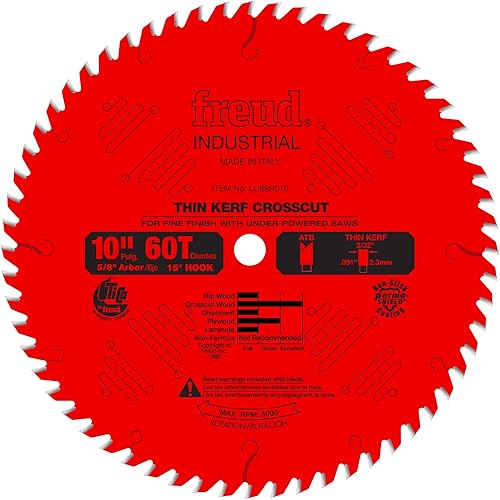
Freud LU88R010 10-Inch Thin Kerf Crosscut Blade: Best for faster feeding
- 10 in diameter
- 60 ATB teeth
- 5/8 in arbor
- 0.090 in kerf
- Positive 15-degree hook angle
Its thin kerf and positive hook angle are designed for easier, faster feeding. Consider it for crosscuts in wood and moldings when your saw's arbor and blade limits match.
Pros
- Thin kerf reduces material removal
- 5/8 in arbor
- Perma-Shield coating
Cons
- Positive hook angle is less suited to buyers seeking a negative-hook blade
The Freud LU88R010 pairs a 0.090 in thin kerf with a positive 15-degree hook angle, a design intended for easier feeding and faster cuts. It has 60 ATB teeth and a 5/8 in arbor.
Freud describes it for clean crosscuts in hardwoods, softwoods and moldings. The Perma-Shield coating is intended to reduce drag and pitch buildup.
Choose it if you want a 10 in thin-kerf crosscut blade with a positive hook angle. Skip it if you specifically want the more controlled feeding associated with a negative-hook design on a sliding saw.
Keep your hands out of the blade path and use the saw's guard as designed. Make sure the work is supported so it cannot tip or pinch the blade as the cut finishes.
Best miter saw blade for extra-fine cuts: Bosch DCB1280
Bosch DCB1280 12-Inch 80-Tooth Saw Blade: Best for extra-fine cuts
- 12 in diameter
- 80 teeth
- Triple-sharp teeth
- C4 micrograin carbide
- Body slots
The triple-sharp teeth are designed for a smooth finish, and body slots help manage heat. Verify the 12 in diameter and arbor match your saw.
Pros
- 80 teeth
- C4 micrograin carbide
- Body slots reduce heat
Cons
- Bosch does not specify an arbor size
The Bosch DCB1280 is a 12 in, 80-tooth blade with triple-sharp teeth for smooth cuts and an extra-fine finish. Bosch also describes its C4 micrograin carbide as impact resistant and its body slots as a way to manage heat.
Bosch does not specify an arbor size for this blade, so check that measurement with Bosch or your saw manual before choosing it. Its stated features make it worth considering for finish cuts on a compatible 12 in saw.
Pick the Bosch when the triple-sharp tooth design appeals and fit is confirmed. Skip it if you cannot verify the arbor size or if your saw takes a 10 in blade.
Avoid assuming that a brand match means a fit match. Confirm diameter, arbor and allowed speed for your exact saw model before ordering.
Best miter saw blade for general woodcuts: WEN BL1060
WEN BL1060 10-Inch 60-Tooth Saw Blade: Best for general woodcuts
- 10 in diameter
- 60 carbide-tipped teeth
- 5/8 in arbor
- 0.1 in kerf
- For hard and softwood
This 60-tooth blade has a 5/8 in arbor and is designed for hard and softwood cutting. Its 10 in diameter suits only saws designed for that size.
Pros
- 5/8 in arbor
- For hard and softwood
- Compatible with most 10 in miter saws
Cons
- 60 teeth are a more general choice than the 80-tooth finish options
The WEN BL1060 offers 60 carbide-tipped teeth, a 5/8 in arbor and a 0.1 in kerf. WEN describes it for hard and softwood, and says it fits most 10 in miter saws.
Its tooth count is a practical choice for general finish cutting without moving to an 80-tooth blade. The 10 in diameter and arbor still need to match your saw's limits.
Choose it for a straightforward 10 in wood blade with a clearly stated arbor. Skip it if you need a finer tooth pattern for delicate trim or a blade intended for material other than wood.
For routine jobs, a 60-tooth blade can cover many crosscuts without the slower feed of some finer options. If you regularly cut visible edges in hardwood or trim, compare it with an 80-tooth blade instead.
How do you match a blade to your miter saw?
Match the blade diameter and arbor first, then confirm the blade type and speed limits in your saw manual. A blade that looks close in size may still be incompatible.
Diameter controls the blade's reach and clearance under the guard. Arbor is the center hole that mounts on the saw, so a 1 in arbor and a 5/8 in arbor are not interchangeable unless the saw maker approves an adapter.
Also check the blade's maximum RPM against the saw's rated speed. Do not assume a blade is suitable just because it fits physically.
Check the manual for the blade materials the saw is meant to cut. A blade listed for wood is not a general-purpose choice for every material, and a blade's tooth count does not change that.
If you are still choosing the saw, our guide to compound miter saw sizes and types explains how saw style affects the cuts you can make. For the difference between angled cuts, see miter cuts versus bevel cuts.
How do tooth count and tooth shape affect the cut?
A 60-tooth blade is a useful starting point for general crosscuts, while an 80-tooth option can suit finer work. Tooth shape and hook angle also matter, so tooth count alone cannot predict every cut.
A higher tooth count places more teeth along the rim, which can help leave a smoother edge when the blade is sharp and the work is supported. It may also call for slower feeding than a coarser blade.
ATB means alternating top bevel, a common tooth arrangement on crosscut blades. Hi-ATB, ATAF and ATAFR describe other tooth patterns in these picks, so compare the intended cut and material rather than assuming those labels mean the same thing.
Hook angle describes how the teeth meet the work. The Freud LU91M010's negative hook angle is designed to reduce climbing on sliding saws, while the LU88R010's positive hook angle is designed for easier, faster feeding.
For trim and baseboards, a higher tooth count can be useful, but make a cut on scrap first. Our guide to miter saw blade tooth counts explains how tooth design relates to finish and feed rate.
Does a thin kerf blade cut better?
A thin kerf blade removes less material and can need less power, which may help on a saw with limited power. It does not automatically produce a better finish, so consider tooth design and intended use as well.
The Freud LU91M010 and LU88R010 both list a 0.090 in kerf. The Makita A-93681 also describes its kerf as ultra-thin, but a thin blade still needs to meet the saw maker's requirements.
Kerf is the width of the slot the teeth cut. A narrower kerf can leave more of the workpiece intact and reduce cutting load, but it does not solve problems caused by a dull blade, poor support or a rushed feed.
If a cut looks rough, first check blade condition, stock support and feed. The guide to miter saw blade tooth counts covers another factor that can affect the edge.
How do you choose a blade for trim and baseboards?
Choose a sharp blade with enough teeth for clean crosscuts, then try it on scrap from the same material. For many trim tasks, an 80-tooth option is a useful comparison if the blade fits your saw.
Support the baseboard against the fence and hold it securely with the saw's approved clamp or hold-down method. Small offcuts can shift, so keep them supported and follow the saw manual.
Set the angle carefully and make a scrap cut before trimming a finished piece. This lets you check the fit and the face of the cut without wasting your final stock.
For corner cuts, the blade is only part of the setup. See how to cut baseboard corners before making finished cuts.
What setup helps a blade make a clean cut?
A stable saw, supported stock and a steady feed help a sharp blade make a clean cut. Begin with the saw unplugged when changing a blade, and follow the manual's steps for the guard, washer and arbor bolt.
Check that the new blade's rotation direction matches the arrow on the saw. Tighten the blade using the method in the manual, then move the blade through its travel by hand only while the saw is unplugged to check for contact or obstruction.
Before a cut, clear the table and fence, set the angle, and clamp or hold the stock as the manual directs. Keep the work flat and tight against the fence so it cannot roll or move as the blade enters.
Start the saw and allow it to reach full speed before cutting. Lower the blade smoothly, avoid forcing it through the material, and wait for it to stop before lifting it from the cut.
Wear eye and hearing protection and keep hands clear of the blade path. Follow the safety instructions supplied with your saw, especially for narrow stock and offcuts.
What common blade mistakes should you avoid?
The most common buying mistake is choosing by diameter alone. Arbor, blade type, speed rating and the saw maker's limits must also match.
Another mistake is buying the highest tooth count for every job. A fine blade may suit trim and visible edges, while a more general blade can make sense for routine crosscuts where speed matters.
Don't use a blade for a material outside its intended use. The WEN BL1060 and Makita B-66977 are described for wood, while other picks name broader material compatibility.
Don't force a slow cut by pushing harder. A steady feed helps the teeth cut cleanly and gives you more control over the work.
Finally, don't treat a rough edge as proof that you need a new blade size or tooth count. Check for pitch buildup, a dull or damaged tooth, loose stock, and the way the work is supported before changing the blade.
How should you care for a miter saw blade?
Keep the blade clean and inspect it for buildup, missing teeth or visible damage before use. A dirty blade can cut less smoothly, and damaged teeth are a reason to stop and follow the saw and blade maker's guidance.
Remove the blade only with the saw disconnected from power, using the maker's procedure. Clean it with a method suitable for the blade and its coating, and dry it before storage to help limit corrosion.
Store spare blades so the teeth are protected from knocks and contact with other tools. Avoid dropping a blade or resting it where the tooth tips can strike a hard surface.
Coatings such as Silver Ice and PermaShield are described as resisting buildup, friction, heat or corrosion, but they do not remove the need for basic care. Clean blades when buildup affects the cut and replace a blade that is damaged or no longer cuts safely.
How do you choose between 10-inch and 12-inch blades?
Choose the diameter your saw was designed to use. A larger blade is not a safe upgrade for a smaller saw, and two 12 in blades may still have different arbor requirements.
Among these picks, several 10 in blades have a stated 5/8 in arbor, while the Diablo 12 in Hi-ATB blade has a 1 in arbor. Check your manual for both measurements and any blade restrictions.
If you're considering a larger saw for wider stock, compare the machine's capacity and footprint before buying. Our sliding compound miter saw guide explains how rails affect crosscut capacity.
Which best miter saw blade should you choose?
Choose the Freud LU91M010 for controlled crosscuts on a compatible sliding saw, the Diablo D1080X or Makita A-93681 for fine work on a 10 in saw, and a 12 in pick only when both diameter and arbor fit. Then match tooth style and kerf to your material and finish needs.
Choose the Freud LU88R010 if easier feeding is your priority, or the WEN BL1060 for general woodcuts with a clearly stated arbor size. If the blade's arbor is not specified, confirm it before buying.
For trim work, pair the right blade with careful support and a scrap cut. If you're learning the cut itself, start with our baseboard corner guide.
Sources
Our top 3 picks at a glance
-
1
Best for controlled crosscuts
Freud LU91M010 10-Inch 60-Tooth Miter Saw Blade
8.9/10 our score
See it on Amazon -
2
Best for 12-inch finish work
DeWalt DWA11280 12-Inch 80-Tooth Miter Saw Blade
8.7/10 our score
See it on Amazon -
3
Best for fine woodworking
Diablo D1080X 10-Inch 80-Tooth Miter Saw Blade
8.6/10 our score
See it on Amazon
Frequently asked questions
How many teeth should a miter saw blade have?
For many crosscuts and trim jobs, a blade with 60 to 80 teeth is a useful starting point. More teeth can make a smoother cut, while fewer teeth can feed faster.
Match the blade to the material, finish needs and saw, then see our miter saw blade tooth guide for more detail.
Can I put a 12-inch blade on a 10-inch miter saw?
No. Use only the blade diameter allowed by your saw.
A larger blade can exceed the guard and clearance design, so check the manual and the saw's markings before buying.
Does a thin kerf blade fit any miter saw?
No. Thin kerf describes the width of material the blade removes, not its fit.
Check the diameter, arbor, blade type and saw maker's limits, especially if the manual specifies a minimum blade body thickness.
What is the difference between a miter saw blade and a circular saw blade?
The label alone does not settle compatibility. A blade must match the saw's diameter, arbor, speed rating and intended material, along with any restrictions in the manual.
Some blades are described for several saw types, but confirm your exact saw requirements first.
How do I choose a blade for baseboard corners?
A sharp blade with 60 to 80 teeth can help leave clean trim cuts, but the right choice depends on your saw and the baseboard material. Support the work and make a test cut on scrap before trimming finished pieces.
See our baseboard corner cutting guide.