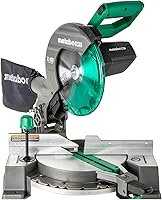
Compound Miter Saws: Sizes, Types and Picks
A compound miter saw tilts its blade for bevel cuts and turns it for miter cuts. Choose a 10-inch saw for many home projects, a 12-inch model for more blade reach, or a sliding saw when you need wider crosscuts.
On this page (8 sections)
- What does a compound miter saw do?
- Which compound miter saw size should you choose?
- What are the main types of compound miter saws?
- Which compound miter saw fits your work?
- What should you compare before buying?
- Which saw should you choose for common projects?
- What safety steps matter with a compound miter saw?
- Which compound miter saw should you pick?
A compound miter saw turns its blade for miter cuts and tilts it for bevel cuts. Choose a 10-inch saw for many home projects, a 12-inch model for more blade reach, or a sliding saw when you need wider crosscuts.
The right choice depends on the material you cut, the angles you need, and the space available for the saw. Blade diameter is only one part of that decision: bevel direction, sliding action, cut capacity and setup all matter.
This guide explains the main types and sizes, then matches four saws to common needs. For a basic overview of the tool's jobs, see what a miter saw is used for.
What does a compound miter saw do?
A compound miter saw makes miter cuts across a board and bevel cuts through its thickness. Since the head can turn and tilt, you can set either angle or combine them for a compound angle.
A miter cut changes the angle across the board's face. A bevel cut tilts the blade through the board.
The terms describe different movements, even though a cut can use both at once.
For example, trim around a corner may need a miter to meet the adjoining piece. Crown molding can also need a bevel so its angled edges sit neatly against the wall and ceiling.
A compound saw can also make a straight crosscut when its miter and bevel are set to zero. It is designed for crosscuts and angled cuts, not for ripping long boards lengthwise.
The term compound does not tell you whether the saw slides or bevels in both directions. Those are separate features to compare.
Which compound miter saw size should you choose?
Choose blade size based on the material and cut capacity you need, then verify the saw's stated limits. A 10-inch blade is a common fit for home trim and smaller workpieces; a 12-inch blade can provide more reach, but it does not guarantee any specific cut size.
The blade diameter is not the same as the saw's maximum cut width or height. The head design, fence and sliding action also affect capacity.
| Size or design | A practical starting point | What to check |
|---|---|---|
| 10-inch fixed head | Trim, small boards and general home projects | Stated crosscut and bevel capacity |
| 10-inch sliding | Wider boards with a compact blade size | Rail travel and room needed behind the saw |
| 12-inch fixed head | More blade reach for larger workpieces | Cut capacity at the angles you use |
| 12-inch sliding | Wider cuts and larger stock | Full footprint, support and rated capacity |
If you regularly cut a particular board size, compare the saw's published capacity at the exact angle you need. Capacity at 90 degrees may differ from capacity at a miter or bevel.
A larger blade can also mean a larger, heavier saw. Measure your bench or stand, consider how you will move the tool, and leave room to support long stock.
Is a 10-inch compound miter saw big enough?
A 10-inch compound miter saw is big enough when its published capacity covers your usual workpieces. Many trim and DIY tasks fit this size, but the blade number alone cannot confirm that a board will clear the fence or complete a cut.
The Metabo HPT C10FCG2 is a 10-inch, single-bevel compound saw with a 0–52° miter range left and right and a 0–45° bevel range to the left. Its 24 lb weight may also suit a buyer who needs to move a saw between storage and a work area.
Before choosing it for a wide board, check the model's cut capacity. A fixed-head saw does not gain the extra crosscut reach that sliding rails can provide.
What are the main types of compound miter saws?
Compound miter saws vary by bevel direction and sliding action. Decide which angles you repeat and how wide your stock is before paying for features you may not use.
Single-bevel compound saws
A single-bevel saw tilts left or right, depending on the model, but not both ways. To make matching bevels in the opposite direction, you may need to turn the workpiece or reset the saw.
That can be a reasonable trade-off if your cuts mostly use one bevel direction. The Metabo HPT C10FCG2, for instance, has a bevel range of 0–45° to the left and a 0–52° miter range in either direction.
Dual-bevel compound saws
A dual-bevel saw tilts left and right, so you can make bevels in either direction without flipping the board. That can save setup steps when a project calls for repeated matching cuts.
The DeWalt DWS716 is a 12-inch, double-bevel compound saw. Its bevel range is 0–48° in both directions, and its miter range is 0–50° left and right.
The trade-off is that dual-bevel movement does not by itself increase crosscut width. Check the saw's cut capacity and decide whether the larger blade and two-way tilt fit your work.
For more on how two-way tilt works, read what a dual-bevel miter saw is.
Sliding compound saws
A sliding saw moves the blade head along rails, which can help it crosscut wider boards than a fixed-head design. Check both the capacity and the space needed for the rails, since some saws extend behind the body.
The Skil MS6305-00 combines a 10-inch blade, dual bevel and sliding action. It cuts lumber up to 2x12 at 90° and 2x8 at 45°.
Sliding saws add reach, but they can take more room and may weigh more than basic fixed-head models. See what a sliding compound miter saw is for a closer look.
Glide-style sliding mechanisms
Some sliding saws use a linked arm system instead of long rails. Bosch says the CM10GD's Axial-Glide system reduces the saw's front-to-back footprint by up to 10 in compared with slide saws with similar capacities.
This model has a 10-inch blade, dual-bevel movement and a 15 A motor. Bosch gives its horizontal cut capacity as 12 in, with stated vertical baseboard and nested crown capacities as well.
Which compound miter saw fits your work?
Choose based on the feature that solves your main constraint: blade reach, portability, wider crosscuts or limited workspace. These examples show how those priorities point to different designs.
| Saw | Design | Useful fit |
|---|---|---|
| Skil MS6305-00 | 10-inch, dual bevel, sliding | Wider crosscuts and two-way bevels |
| Metabo HPT C10FCG2 | 10-inch, single bevel | Portable fixed-head design |
| DeWalt DWS716 | 12-inch, double bevel | Larger blade and bevels in either direction |
| Bosch CM10GD | 10-inch, dual bevel, glide | Sliding action with reduced front-to-back footprint |
Our score weighs specs, features and buyer feedback against what you're shopping for.
The Skil MS6305-00 may fit if you need a sliding saw and want a 2x12 crosscut at 90° and a 2x8 crosscut at 45°. Its LED shadow line helps show blade position, while the dual-bevel design handles bevel cuts in either direction.
The Metabo HPT C10FCG2 may fit if moving and storing the saw is a priority. At 24 lb, it weighs less than the other three examples here, and its single-bevel design keeps setup straightforward when your work does not call for bevels in both directions.
The DeWalt DWS716 may fit if you want a 12-inch blade and double-bevel adjustment. Its stainless-steel miter detent plate has 14 positive stops, and its sliding fences support crown molding up to 6-5/8 in nested and base molding up to 6-1/2 in vertically against the fence.
The Bosch CM10GD may fit a workshop where front-to-back space is tight. Its articulated hinge arms reduce that footprint compared with slide saws of similar capacity, while its dual-bevel design supports cuts in both directions.
The listed capacities describe each model's stated limits, not every possible board or setup. Check the manual and support the workpiece properly, especially for long or heavy stock.
What should you compare before buying?
Compare cut capacity, angle range, bevel direction, work support and footprint. These details matter more than choosing a saw by blade size alone.
- Write down your largest common workpiece. Include its width and thickness, plus the angle you need to cut.
- Check the cut capacity at that angle. A capacity figure at 90° may not apply to a mitered or beveled cut.
- Choose single or dual bevel. Dual bevel is useful if your work repeats cuts in both directions.
- Decide whether you need sliding action. Use it when your material is wider than a fixed-head saw can crosscut.
- Measure the setup area. Account for rails, the saw's movement, fence clearance and space for infeed and outfeed support.
- Plan for moving and storage. Compare the tool's weight and shape with where it will live between projects.
- Check included workholding and visibility features. A clamp or blade-position guide can help with setup, but still secure the material and check your marks.
Miter detents can make common angles quicker to set. If your project needs an uncommon angle, check whether the saw lets you adjust between stops and lock the setting securely.
A laser or shadow line can help indicate the blade path, but it does not replace accurate measurement or a test cut. For more on that choice, read whether a miter saw laser guide is worth having.
Which saw should you choose for common projects?
Choose a saw whose angle controls and capacity match the cuts you make most often. For occasional trim, prioritize fit and ease of setup; for repeated wide cuts, prioritize sliding capacity and material support.
For baseboards and other trim, compare the board height against the saw's fence and vertical capacity. A larger blade may help with reach, while dual bevel may reduce the need to turn the workpiece on repeated opposite-side cuts.
For wide boards, a sliding saw can add crosscut capacity. Confirm the exact width and thickness it can handle at the intended angle, and make sure your bench or stand supports the board on both sides.
For occasional DIY work, a fixed-head 10-inch saw can be a practical starting point if its capacity covers your materials. The Metabo HPT's 24 lb design may matter if you need to put the tool away after each project.
For a compact workshop, compare the saw's full movement area, not just its base dimensions. Bosch says the CM10GD's glide mechanism uses less front-to-back space than comparable rail saws, but you still need safe room for the material and your hands.
If you are unsure whether a miter saw belongs in your tool set, our guide to whether you need a miter saw for DIY projects helps compare it with simpler options.
What safety steps matter with a compound miter saw?
A compound miter saw needs a stable setup, supported workpiece and clear blade path. Read the manual for the exact model, and use its guards and workholding features as directed.
Set the saw on a level, secure surface. Support long stock so it stays flat against the table and fence, and clamp small or awkward pieces when the manual allows it.
Keep hands outside the marked danger area and away from the blade path. Wait for the blade to stop before raising the head or removing offcuts.
Wear eye and hearing protection, and manage dust with the method recommended by the manufacturer. Never reach near the blade to clear dust or scraps while it is moving or powered.
Which compound miter saw should you pick?
Choose the Skil MS6305-00 if you need a 10-inch dual-bevel sliding saw with stated crosscut capacities of 2x12 at 90° and 2x8 at 45°. Choose the Metabo HPT C10FCG2 for a lighter 10-inch fixed-head saw, the DeWalt DWS716 for a 12-inch blade and double-bevel movement, or the Bosch CM10GD when you want glide action with a reduced front-to-back footprint.
Start with the board sizes and angles you use most, then confirm the model's capacity and footprint. If wider cuts are the deciding factor, compare sliding vs compound miter saws before choosing.
Frequently asked questions
What is a compound miter saw?
A compound miter saw turns its blade left or right for miter cuts and tilts it for bevel cuts. Those two movements let you cut an angle across the face of a board and an angle through its thickness, as used for some trim corners and frames.
Is a 10-inch or 12-inch compound miter saw better?
A 10-inch saw can suit common trim and home projects, while a 12-inch saw offers a larger blade and may provide more cutting reach. Blade size alone doesn't tell you the width or thickness a saw can cut, so check its stated capacity against your material.
Do I need a sliding compound miter saw?
Choose a sliding compound miter saw if your projects include boards wider than a fixed-head saw can crosscut. The rails let the blade travel through a wider piece, but the saw needs room behind it unless its design uses a different mechanism.
What is the difference between single and dual bevel?
A single-bevel saw tilts in one direction, so you may need to turn the workpiece to make matching bevels on opposite sides. A dual-bevel saw tilts left and right, which can make repeated trim work easier when both directions are needed.
Can a compound miter saw cut straight?
Yes. Set the miter and bevel angles to zero for a straight crosscut, then support the board against the fence and table.
Keep hands clear of the blade path, secure the work, and wait for the blade to stop before lifting it.