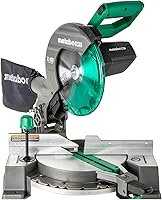
How Does a Sliding Miter Saw Work?
A sliding miter saw works by mounting the blade on rails so the head glides forward and back as well as swinging left and right. You pull the head out, start the motor, and push it down and back through the board, which lets a 10-inch blade crosscut stock much wider than a fixed saw could.
On this page (9 sections)
- How does a sliding miter saw work compared with a fixed miter saw?
- What does each part do when the blade slides forward?
- How do you actually make a cut with a sliding saw?
- How wide a board can a sliding miter saw cut?
- What do miter and bevel angles change in the cut?
- Why does a sliding saw need a specific blade?
- How do the rails affect accuracy and footprint?
- What should you check before buying a sliding miter saw?
- What's the simplest way to think about how a sliding miter saw works?
A sliding miter saw works by putting the blade on rails so the head glides forward and back, not just side to side. You pull the head out, start the motor, and push down and through the board, and the sliding travel lets a 10-inch blade crosscut stock much wider than a fixed saw can manage.
That extra motion is the whole point. A fixed miter saw tops out around 6 inches of crosscut width; a sliding one can reach about 12 inches.
The trade is more moving parts, a deeper footprint, and a habit you have to learn: pull first, cut second.
How does a sliding miter saw work compared with a fixed miter saw?
The rails are the difference. A fixed saw pivots on a single arm, so the blade only arcs downward and the cutting width is capped by the blade's diameter.
A sliding saw adds a carriage that runs along two rails, and the head can travel 10 to 14 inches or more before it ever touches wood.
That travel matters when you cut wide trim, shelving, or fence boards. A 10-inch fixed saw leaves wide stock needing a flip and a second cut.
A 10-inch sliding saw, such as the Makita LS1019L, can crosscut crown molding nested at up to 6-5/8 inches and baseboard at up to 4-3/4 inches.
The mechanics are simple to picture. The blade spins on a motor mounted to the carriage.
The carriage rolls on linear bearings or a rail sleeve. A spring or gas strut holds the head up until you push it down.
For the fixed-saw version, see our guide to how a compound miter saw works.
What does each part do when the blade slides forward?
Each part has one job, and knowing them makes the first cut less confusing. The base holds the stock and the fence squares it.
The table rotates for miter angles. The bevel pivot tilts the whole head left or right.
The rails and carriage carry the blade through the cut.
The fence is the part beginners underuse. Press the board flat against the base and tight to the fence, and the blade tracks straight.
A quick-clamp or vertical vise, like the one bundled with the Makita LS1019L, holds the work so your hands stay clear.
The blade guard retracts as the head comes down and covers the teeth again on the way up. The laser or LED cutline, fitted to models like the WEN MM1015, throws a shadow or line on the stock so you can line up the mark before pulling the trigger.
How do you actually make a cut with a sliding saw?
Set the angle, pull the head out, start the motor, then push down and back. That sequence keeps the blade buried in the wood as it exits and helps prevent the saw from grabbing.
- Unplug the saw or remove the battery before changing the blade or making adjustments.
- Set the miter angle on the table and lock it, then set the bevel if you need one.
- Place the board against the fence and clamp it.
- Pull the head fully toward you without touching the wood.
- Start the motor and let it reach full speed.
- Push the head down and away through the cut, then release the trigger and let the blade stop before lifting it.
The pull is not optional. Starting the motor with the blade already over the board invites kickback.
Pulling first also gives the blade a clear run-up so the teeth meet the wood at full speed.
How wide a board can a sliding miter saw cut?
A 10-inch sliding saw usually crosscuts boards up to about 12 inches wide, though the exact figure depends on the model and whether the cut is square or angled. The WEN MM1015 is rated for boards up to 12 inches wide and 3.75 inches thick with its 15 amp motor.
Capacity shrinks as the angle changes. The same WEN saw handles compound cuts at 45 degrees bevel and 45 degrees miter in stock up to 8.5 inches wide and 2.6 inches thick.
That's normal: the wider the miter or bevel, the narrower the reachable width.
For anything past 12 inches, plan on flipping the board and cutting from the other side. Check the scale first, because a flipped board's mark lands on the opposite face.
The sliding miter saw roundup lists models with their stated capacities if width is your main concern.
What do miter and bevel angles change in the cut?
Miter turns the table under the blade; bevel tilts the blade itself. Miter angles cut trim for corners.
Bevel angles cut the slanted face of baseboard and crown.
A dual-bevel saw tilts both left and right, so you don't have to flip the board for a matching cut on the other side. That's why the Makita LS1019L and the WEN MM1015 are both dual-bevel machines.
Single-bevel saws tilt one way only and cost less.
Compound cuts combine both at once. Crown molding is the classic case: you set a miter and a bevel together and the blade meets the molding at the angle the ceiling and wall form.
A saw with miter detents at 15, 22.5, 31.6, and 45 degrees, as the WEN MM1015 has, makes those settings quick to lock.
Why does a sliding saw need a specific blade?
Sliding saws want a blade with a negative hook angle, because the head moves toward the operator as well as down. A negative hook pushes the work down and against the fence instead of pulling the saw forward.
The Freud LU91M010 is built for exactly this: a 10-inch, 60-tooth blade with a -5 degree hook angle and a thin 0.090 inch kerf. Its teeth are arranged in an alternating top bevel pattern for clean crosscuts in wood 1/2 to 2-3/4 inches thick.
A blade meant for a table saw can work, but its positive hook angle makes it more aggressive in a sliding saw. If you're replacing a worn blade on a new saw, match the tooth count and hook angle to the material you cut most.
How do the rails affect accuracy and footprint?
Rails come in two layouts: a single tube or twin steel rails. Twin rails share the load and keep the head from rocking as it travels.
The Makita LS1019L uses a 2-steel rail design with linear ball bearings, and Makita says the system is engineered for dead-on cuts.
The rail layout also decides where the saw can sit. A saw with rails mounted forward can run flush against a wall, and the Makita's compact design is built for that.
A saw with rails running straight back needs clearance behind it.
Accuracy comes from the bearings more than the rail count. Worn or gritty bearings show up as a wandering cut or a head that wobbles at full extension.
Wipe the rails after dusty jobs and keep them free of sawdust and pitch.
What should you check before buying a sliding miter saw?
Check crosscut width, bevel direction, weight, and whether the saw is corded or cordless. Those four decide whether the tool fits your bench and your jobs.
Width first. If you cut 1x6 trim all day, a fixed saw covers it.
If you cut 1x10 shelving or wide crown, you need a slider. The sliding compound miter saw explainer covers the compound part of that name in more depth.
Weight matters if the saw moves between sites. The WEN MM1015 weighs 48 lb.
Corded saws run off a 15 amp circuit. A cordless sliding miter saw trades some power for freedom from an outlet.
Check your bench space and the outlet before you decide.
What's the simplest way to think about how a sliding miter saw works?
It's a miter saw on rails. The blade swings to set the angle and slides to reach wide stock, so you pull it toward you, start the motor, and push it through the board.
That one extra motion is what makes a 10-inch sliding saw cut boards a fixed saw can't reach.
The practical rules are short. Pull before you cut.
Keep the board against the fence. Use a blade with a negative hook angle.
And measure the saw's footprint before you buy, because the rails need room to travel.
If you're ready to compare models, the best sliding miter saws guide puts the picks side by side. For a saw that runs without a cord, see the cordless sliding miter saw roundup.
For the broader category, our sliding compound miter saw page explains what the compound in the name adds.
Frequently asked questions
How does a sliding miter saw work differently from a non-sliding one?
A sliding saw rides on rails, so the blade moves forward and back in addition to swinging through miter and bevel angles. That extra travel lets a 10-inch sliding saw crosscut boards up to about 12 inches wide, while a fixed 10-inch saw stops around 6 inches.
Do you pull or push a sliding miter saw through the cut?
Pull the head fully toward you before starting the motor, then push it down and away from you through the board. That order keeps the blade buried in the stock on the way out and reduces the chance of the saw grabbing or climbing.
Why do sliding saws have two rails instead of one?
Two rails share the load and keep the head steadier as it travels. The Makita LS1019L, for example, uses a 2-steel rail design with linear ball bearings, which the brand says keeps cuts accurate while shrinking the saw's footprint so it can sit flush against a wall.