How to Adjust a Miter Saw
To adjust a miter saw, square the blade to the table and fence first, then set the miter pointer to 0° and confirm the bevel stop at 0°. Check a test cut against a square before trusting the marks on any project.
On this page (10 sections)
- Why should you adjust a miter saw before you cut?
- How do you square the blade to the table and fence?
- How do you set the miter angle and zero the pointer?
- How do you set the bevel stop and lock?
- How do you set the fence and the clamp for a safe cut?
- How do you check the settings with a test cut?
- Which saws make adjustment easier?
- What should you do when the saw will not stay in adjustment?
- How do you keep the settings accurate over time?
- Final word on adjusting your miter saw
To adjust a miter saw, square the blade to the table and fence first, then set the miter pointer to 0° and confirm the bevel stop at 0°. Check a test cut against a square before trusting the marks on any project.
Most settings for how to adjust a miter saw come down to two things: square at zero and an honest pointer. The rest is small work you can do in a few minutes.
Why should you adjust a miter saw before you cut?
Adjust first because a small error multiplies along the piece. A blade a fraction of a degree off square shows as a gap at the end of a long board or a bad corner joint.
The first thing to check is whether the blade sits square to the table when the head is down. A saw that cuts fine at 0° but drifts at 45° usually has a detent or stop problem rather than a blade problem.
If you are still working out which kind of saw you have and what each part does, our guide to what a miter saw is used for covers the basic parts. The miter scale sits under the turntable, the bevel lock is usually at the back or the side, and the fence runs across the table.
Worn blades cause more bad cuts than worn settings. Swap to a fresh blade before you chase a square problem, or you may be adjusting around a bent plate.
How do you square the blade to the table and fence?
Use an engineer's square or a combination square against the blade plate and the table. Lower the head, bring the square to the blade without touching the teeth, and look for light at the joint.
Do this with the saw unplugged. Turn the blade by hand until you find the flattest spot on the plate.
A blade with a damaged tooth can look out of square when the plate itself is fine.
Check the blade against the fence too. On most saws you loosen the fence bolts to move it square, so follow the saw's own instructions before you touch the fence.
Once the blade sits square to the fence and the table, set the pointer to match. That order matters: never move the pointer to follow a blade that is not square.
How do you set the miter angle and zero the pointer?
Release the miter lock, swing to 0°, and lock the head over a positive detent. Then look at the pointer against the scale and adjust it if the mark sits off the 0° line.
The miter scale runs from 0° to about 45° or 52° to either side, depending on the saw. Positive detents hold the head at common angles like 0°, 15°, 22.5°, 31.6° and 45° so you don't have to line up by eye.
Saws with a detent override make this easier. Bosch puts a push-button miter detent override on the CM10GD that lets you adjust to a fine angle without fighting the stops.
DeWalt's DWS713 uses a stainless-steel detent plate with 14 positive stops.
Set the pointer with a small screwdriver if the marks do not line up. Recheck after you make the adjustment and after every move to a new angle.
How do you set the bevel stop and lock?
Set the bevel to 0°, check it against the square, then set the positive stop. The bevel changes the tilt of the head, so a bevel error tips the blade away from square and changes the cut face.
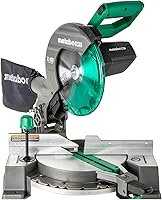
A single-bevel saw like the Metabo HPT C10FCG2 tilts 0–45° to the left only. A dual-bevel saw tilts both ways, and each side needs its own check at 0°.
The bevel lock lever holds the head at the angle you choose. Some saws keep the lever and range selector up front so you don't reach behind the tool, as Bosch does on the CM10GD.
Adjustable bevel stops set the zero point. Loosen the stop, bring the head flat to the table, and tighten it again once the blade sits square.
Use the square, not the scale, to find true 0°.
Check the bevel at 45° as well if you cut crown or base. A stop that is right at 0° can still be off at 45° if the plate or the lever is worn.
How do you set the fence and the clamp for a safe cut?
Square the fence to the blade and set the clamp so the work cannot slide. The fence carries the work against the blade, so a fence that runs off square puts every cut at an angle.
Check the fence with the square along its face and the blade plate. A tall sliding fence adds support for base and crown, like the DeWalt DWS713 fence that holds 4-1/4 inches of base vertically.
The clamp is a separate setting from the fence. The Metabo HPT C10FCG2 uses a vice clamping system that holds the work down against the table.
A workpiece that shifts during the cut will come out off square no matter how good the settings are.
Set the work flat on the table against the fence and tighten the clamp just enough to hold it. Keep fingers clear of the blade path and let the head come to a full stop before you lift it.
How do you check the settings with a test cut?
Cut a scrap piece and check the end with a square. If light shows under the square, adjust the settings and cut again before you touch a real board.
Use a piece of the same material you plan to cut. Trim behaves differently from a 2x4, and a blade that leaves a rough edge on thick stock can look square while the face is off.
Cut one end at 0° and one end at the angle you plan to use, then check both. If the saw cuts square at 0° but not at 45°, the detent or the bevel stop is the place to look.
The blade itself rarely changes squareness between two angles.
Repeat the test after you move the saw. A saw knocked in transport or set down hard can lose its square setting.
Which saws make adjustment easier?
Saws with clear scales, positive stops and up-front locks are easier to set and recheck. The three saws here all have those features to some degree, and each suits a different buyer.
The Metabo HPT C10FCG2 has an improved miter scale and controls plus a 0–52° miter range left and right. It weighs 24 lbs, so it is easy to set on a bench and move when the job is done.
The DeWalt DWS713 uses a stainless-steel miter detent plate with 14 positive stops and a machined base fence support. That plate is the part you check when a detent starts to feel vague.
The Bosch CM10GD puts the bevel lock lever and range selector up front and adds an axial-glide system. Its miter detents sit at 0, 15, 22.5, 31.6, 45 and 60, with an override for fine angles.
All three take a 10-inch blade. Blade size matters for adjustment because the square check and the bevel stop both work against the blade plate.
If you are weighing the simpler saw against a compound model, our comparison of miter saw vs compound miter saw explains which settings each one has. A plain miter saw only swings the head; a compound saw adds the bevel tilt.
What should you do when the saw will not stay in adjustment?
Check the blade, the arbor and the pivot before you blame the scale. A blade with a bent plate or a loose arbor bolt will not hold square no matter how carefully you set the pointer.
Look for a wobbling blade with the saw unplugged. Spin it by hand and watch the edge against a fixed point; a wobble means the blade or the mounting is the problem.
A head that moves when locked points to a worn detent plate or a loose lock. Tighten the lock and try the test cut again.
If the saw cuts off square only under load, the fence or the table may be flexing.
For a saw that keeps drifting, compare what you would pay for a replacement against a repair. A budget miter saw may cost less than a major repair, and a compact miter saw fits a small shop where a full-size saw would not.
How do you keep the settings accurate over time?
Check square and the pointer after every blade change, every move and any hard knock. Those are the moments when settings move.
Store the saw with the head locked down. A saw left unprotected can take a knock on the head and lose its bevel stop.
Wipe the scale and the pointer so you can read the marks.
Replace worn blades and keep the arbor bolt snug. Check the fence bolts and the bevel lock for looseness at the same time.
Final word on adjusting your miter saw
The reliable order for how to adjust a miter saw is square first, pointer second, stops last. Set the blade square to the table and fence, set the pointer at 0°, and confirm the bevel stop on both sides.
Then make a test cut. If it is square, the saw is ready.
If not, go back to the blade before you touch the scale.
Pick the saw whose adjustment points you will actually use. A 10-inch saw with a clear scale and positive stops, like the Metabo HPT C10FCG2, is easy to keep in tune for trim and framing work.
Frequently asked questions
How do I know if my miter saw is out of adjustment?
A cut that runs slightly off square when the pointer sits at 0° is the usual sign. Test with a square against the cut end, and check that the blade sits flat against the table and fence before you move the pointer.
How do you set the miter angle on a miter saw?
Release the miter lock, swing the head to the angle you want, and stop at a positive detent when one exists. Tighten the lock and set the pointer to match, then make a test cut to confirm the mark is honest.
Can you adjust the bevel on a single-bevel miter saw?
Yes, a single-bevel saw tilts to one side only, so you set the bevel stop and lock on that side. Dual-bevel saws tilt both ways and each side needs its own check at 0°.
Why does my miter saw cut slightly off square?
The common causes are a blade that is not square to the table or fence, a pointer that has drifted from its mark, or a detent plate that has worn. Square the blade first, then move the pointer to match.
How often should I check the settings on a miter saw?
Check square after moving the saw, changing the blade or knocking the fence. A quick square test takes a minute and saves a whole run of trim cut at the wrong angle.