What Is a Miter Saw Used For?
A miter saw is used to crosscut boards and make angled cuts, such as corners in trim and frames. A compound model can also bevel the blade, while a sliding model can cut wider boards.
On this page (6 sections)
A miter saw is used to crosscut boards and make angled cuts for trim, frames, flooring, and other projects. Some models also tilt the blade for bevel cuts, and sliding models let you cut wider boards.
Set the board against the fence, secure it, and lower the blade through the material. The saw stays in place while you position and support each workpiece.
What is a miter saw used for most often?
A miter saw is used most often to cut boards to length and make repeatable angled ends. It works well for trim pieces, framing lumber, flooring, and other stock that fits safely on its table.
A square crosscut leaves the board end at 90 degrees to its length. Angled cuts can join pieces at corners or fit them around walls, floors, and ceilings.
A miter saw is not meant to rip a board lengthwise. For long cuts along the grain, use a suitable saw designed for ripping.
What kinds of cuts can a miter saw make?
A basic miter saw makes straight crosscuts and miter cuts. Compound models add bevel cuts by tilting the blade, and a sliding rail lets the blade travel across wider stock.
The cut depends on how you set the saw:
- Crosscut: cuts across a board's width, usually at 90 degrees.
- Miter cut: angles across the face of the board, often for corners.
- Bevel cut: tilts through the board's thickness.
- Compound cut: combines a miter angle and a bevel angle.
For a closer look at the difference, read miter cut vs bevel cut. The angle needed depends on the joint and the way the pieces meet.
Is a miter saw used for trim corners?
Yes. A miter saw is often used to cut trim ends at matching angles so two pieces can meet at a corner.
Baseboards, casing, and crown molding may need different setups because they sit in different positions.
For a basic baseboard corner, measure the wall angle and decide whether the joint needs inside or outside cuts. Our guide to cutting baseboard corners with a miter saw explains how to set up those cuts.
What does a compound miter saw add?
A compound miter saw adds a blade tilt for bevel cuts. That lets you cut a miter and bevel together when a trim joint needs both angles.
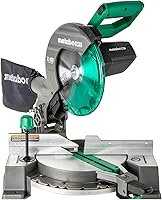
The Metabo HPT C10FCG2 is a single-bevel compound model with left bevel adjustment and a miter range to the left and right. It can suit a home workshop where angled trim and ordinary crosscuts are common.
To see how the saw types differ, compare compound miter saw sizes and types. For a closer look at blade tilt in both directions, see what a dual-bevel miter saw is.
What materials can a miter saw cut?
A miter saw can cut wood and some wood-based materials when the blade and saw are suited to them. The three models here are described for wood; check the saw and blade instructions before cutting any other material.
The workpiece must fit the saw and be supported so it stays flat against the table and fence. Do not force a cut through stock that is too wide, thick, or awkward to hold.
A miter saw is not a substitute for checking the blade's intended material. Use only a blade approved for the saw and the work, and follow the tool's safety instructions.
How do you choose a saw for the work?
Choose a saw based on the width of the boards, the angles you need, and how often you move the tool. A basic compound model can handle common angled cuts; a sliding model can help with wider stock.
The DeWalt DWS713 is a single-bevel compound saw with a tall sliding fence and a miter detent plate with 14 positive stops. It may suit projects that need repeatable angle settings and vertical support for trim.
The Skil MS6305-00 is a dual-bevel sliding model with positive bevel stops and a sliding rail. It may fit a shop where wider crosscuts and bevels in either direction are useful.
Learn what a sliding compound miter saw is before choosing one. If you're deciding whether to buy a saw at all, do you need a miter saw for DIY projects? covers when another tool may be enough.
What should you check before making a cut?
Before cutting, check the saw's capacity, the blade, and the workpiece support. Read the manual, set the angle, and secure the material before powering on.
Keep hands clear of the blade path and wait for the blade to stop before lifting it or removing offcuts. Use eye and hearing protection, and follow the manufacturer's safety directions.
Measure twice, especially when cutting several matching pieces. Test a setup on scrap if the joint or angle is unfamiliar.
What is a miter saw used for, and which type fits?
A miter saw is used for crosscuts and angled cuts in boards. Choose a standard model for basic crosscuts, a compound model when bevels are part of the work, and a sliding model when the stock is too wide for a fixed-head saw's capacity.
For trim corners, focus on accurate angle setup and firm support. For broader boards or compound joints, compare the saw's stated capacity and bevel features before choosing a model.
Frequently asked questions
What is a miter saw mainly used for?
A miter saw is mainly used to crosscut boards to length and cut accurate angles across their width. It suits trim, framing pieces, flooring, and similar stock that fits on the saw, with the workpiece secured against the fence and table.
Can a miter saw cut straight cuts?
Yes. Set the blade at 0 degrees for a square crosscut, then lower it through the supported board.
A miter saw is designed for cuts across stock; it is not the usual tool for ripping a board lengthwise.
What is the difference between a miter and bevel cut?
A miter cut angles across the board's face, while a bevel cut tilts the blade through the board's thickness. A compound cut combines both angles in one cut, which is useful for some trim corners.
Can a miter saw cut wide boards?
A sliding miter saw can cut wider boards than a similar non-sliding saw because the blade travels across the material. The actual width depends on the saw and cut angle, so check its capacity and the board dimensions before starting.