9 Best Budget Miter Saws (October 2026)
The best budget miter saws include the Metabo HPT C10FCG2 10-Inch Compound Miter Saw for everyday woodwork, the Evolution R255SMS+ 10-Inch Multi-Material Sliding Miter Saw for mixed materials, and the Evolution R185SMS+ 7-1/4-Inch Multi-Material Sliding Miter Saw for smaller sliding jobs.
On this page (5 sections)
The best budget miter saw for most wood projects is the Metabo HPT C10FCG2, a 10-inch compound saw with a 15-amp motor, left bevel and 24.2 lb weight. If you need more reach for wide boards, compare the sliding WEN or Evolution options; for a small bench, consider the compact Skil.
Buying on a budget means choosing the features you will use and skipping ones that add bulk without solving your cutting needs. Start with your stock: measure its width and thickness, then check the saw's capacity for the angles you expect to cut.
A fixed-head saw often suits trim, flooring and routine crosscuts. A slider earns its extra space when your boards are too wide for the fixed-head capacity you need.
If you're still deciding which saw type fits your work, start with our guide to compound miter saw sizes, types and picks. For a focused look at fixed-head models, see our best compound miter saws roundup.
Our picks at a glance
-
1
 Best for everyday woodwork
Metabo HPT C10FCG2 10-Inch Compound Miter Saw
9.0/10 our score
See it on Amazon -
2
 Best for mixed materials
Evolution R255SMS+ 10-Inch Multi-Material Sliding Miter Saw
7.5/10 our score
See it on Amazon -
3
 Best for smaller sliding jobs
Evolution R185SMS+ 7-1/4-Inch Multi-Material Sliding Miter Saw
7.4/10 our score
See it on Amazon
- 4
 Check it
Skil SRS0001 7-1/4-Inch Compact Single-Bevel Miter Saw
Best for wall-side benches - 5
 Check it
Dovaman 10-Inch Multi-Material Sliding Miter Saw
Best for extra blade choices - 6
 Check it
Genesis GMS1015LC 10-Inch Compound Miter Saw with Laser
Best for repeat angle cuts - 7
 Check it
Ryobi 10-Inch Compound Miter Saw with LED
Best for LED alignment - 8
 Check it
WEN MM1014T 10-Inch Single-Bevel Sliding Miter Saw
Best for wide-board cuts - 9
 Check it
Seesii 8-1/4-Inch Compound Miter Saw with Laser
Best for small trim projects
How we chose these budget miter saws
We compared blade size, miter and bevel ranges, sliding features, cutline guides and included accessories against common home woodworking needs. The scores reflect how well each saw's features match the jobs budget buyers are likely to tackle.
A fixed-head saw takes up less room behind the tool and keeps the setup straightforward. A sliding model suits wider stock, but needs rail clearance and space to support longer boards.
The picks cover several sizes and uses, from basic wood cutting to compact trim work and multi-material jobs. Use the sections below to see who each saw suits and what to check before buying.
| Product | Best for | Blade | Miter range | Bevel range | Our score |
|---|---|---|---|---|---|
| Metabo HPT C10FCG2 10-Inch Compound Miter Saw | everyday woodwork | 10 in | 0–52° left and right | 0–45° left | 9.0 |
| Evolution R255SMS+ 10-Inch Multi-Material Sliding Miter Saw | mixed materials | 10 in | 50° left and right | 0–45° | 7.5 |
| Evolution R185SMS+ 7-1/4-Inch Multi-Material Sliding Miter Saw | smaller sliding jobs | 7-1/4 in | 50° left and right | 0–45° | 7.4 |
| Skil SRS0001 7-1/4-Inch Compact Single-Bevel Miter Saw | wall-side benches | 7-1/4 in | 0–47° left, 0–50° right | 0–45° left | 7.4 |
| Dovaman 10-Inch Multi-Material Sliding Miter Saw | extra blade choices | 10 in | 7.0 | ||
| Genesis GMS1015LC 10-Inch Compound Miter Saw with Laser | repeat angle cuts | 10 in | 45° left and right | Up to 45° left | 7.1 |
| Ryobi 10-Inch Compound Miter Saw with LED | LED alignment | 10 in | 7.0 | ||
| WEN MM1014T 10-Inch Single-Bevel Sliding Miter Saw | wide-board cuts | 10 in | 6.8 | ||
| Seesii 8-1/4-Inch Compound Miter Saw with Laser | small trim projects | 8-1/4 in | 6.6 |
The best budget miter saws for different jobs
The Metabo HPT is the strongest general-purpose wood pick, while the other saws fit needs such as wider boards, limited bench space or mixed materials. Match a saw's capacity and angle range to your most common work.
1. Metabo HPT C10FCG2 10-Inch Compound Miter Saw: Best for everyday woodwork
Metabo HPT C10FCG2 10-Inch Compound Miter Saw: Best for everyday woodwork
- 10-inch blade
- 15-amp motor
- Miter range of 0–52° left and right
- Bevel range of 0–45° left
- 24.2 lb
A 10-inch blade, adjustable miter range and single bevel cover common wood-cutting needs. Its 24.2 lb weight makes it easier to move than the heavier sliders in this group.
Pros
- Wide miter range
- Vice clamping system
- Lightweight for a 10-inch saw
Cons
- Single bevel only
- No sliding rail
The Metabo HPT C10FCG2 is the best budget miter saw here for a straightforward mix of crosscuts, miters and bevels in wood. Its 10-inch blade, 15-amp motor and 24.2 lb weight make it a balanced option for a home shop or a saw you need to move.
Its miter range runs from 0° to 52° left and right, and its bevel tilts up to 45° left. The vice clamping system helps hold the workpiece in place, while the improved miter scale and controls support angle adjustments.
The saw is corded and comes with a wrench. Metabo HPT includes a 5-year tool-body warranty.
This is a single-bevel saw, so you may need to turn the board to make a bevel in the opposite direction. It also has no sliding rail, which limits its reach compared with a slider.
Choose it for routine wood projects where a 10-inch blade and broad miter range matter more than sliding capacity. Skip it if wide boards are a regular part of your work; compare the WEN or Evolution sliders instead.
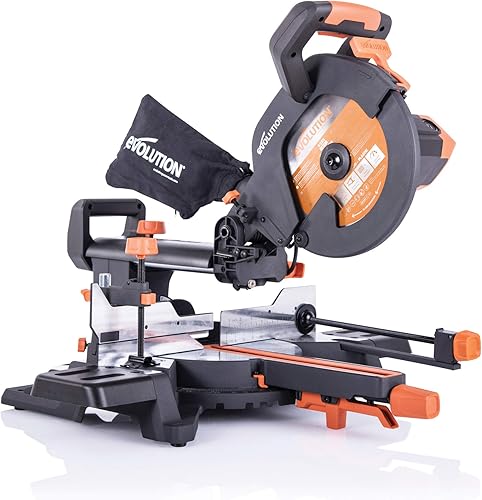
2. Evolution R255SMS+ 10-Inch Multi-Material Sliding Miter Saw: Best for mixed materials
Evolution R255SMS+ 10-Inch Multi-Material Sliding Miter Saw: Best for mixed materials
- 10-inch sliding blade
- Cuts wood, wood with embedded nails, composite decking, mild steel and plastic
- Miter range of 50° left and right
- Bevel range of 0–45°
The sliding design and multi-material blade suit buyers who need more reach and cut more than clean wood. It includes dual quick-release clamps, taller fences and a 3 m cable.
Pros
- Cuts several material types with one blade
- Sliding design
- Dual quick-release clamps
Cons
- Heavier than the fixed-head saws here
- Sliding features may exceed simple trim needs
The Evolution R255SMS+ suits projects that call for sliding reach and cuts in more than wood. Its included blade cuts wood, wood with embedded nails, composite decking, mild steel and plastic.
The 10-inch blade has a miter range of 50° left and right, plus a bevel range of 0° to 45°. The package includes dual quick-release clamps, taller fences, a dust bag and a 3 m cable.
At 41.8 lb, it is less convenient to carry than the fixed-head models. Its sliding rail also needs room behind the saw, so measure the bench and wall clearance before choosing it.
Choose this model if you value sliding reach and multi-material cutting in one saw. Skip it for wood-only trim if you don't need the sliding movement or extra material range.
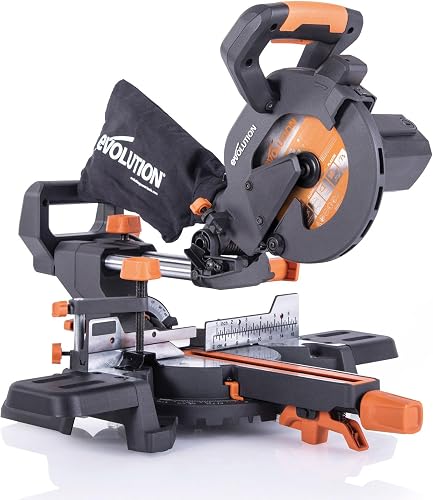
3. Evolution R185SMS+ 7-1/4-Inch Multi-Material Sliding Miter Saw: Best for smaller sliding jobs
Evolution R185SMS+ 7-1/4-Inch Multi-Material Sliding Miter Saw: Best for smaller sliding jobs
- 7-1/4-inch sliding model
- Miter range of 50° left and right
- Bevel range of 0–45°
- Blade included
This smaller Evolution model keeps a sliding format and multi-material cutting in a 7-1/4-inch size. Check its cutting capacity against your stock before choosing it over a 10-inch saw.
Pros
- Sliding reach in a smaller blade size
- Multi-material cutting
- Blade and dust bag included
Cons
- Less blade diameter than the 10-inch options
- Capacity should be checked against your stock
The R185SMS+ offers a smaller blade size with a sliding format and multi-material cutting. It cuts wood, plastic and metal, with a miter range of 50° left and right and a bevel range up to 45°.
The 7-1/4-inch blade may appeal if you want a smaller format than the 10-inch Evolution. It includes a blade and dust bag, but compare its actual cutting capacity with your material before buying.
Choose it when you want sliding reach and multi-material use in a smaller blade class. Skip it if you need a known wide-board capacity and haven't confirmed that the saw can handle your stock.
4. Skil SRS0001 7-1/4-Inch Compact Single-Bevel Miter Saw: Best for wall-side benches
Skil SRS0001 7-1/4-Inch Compact Single-Bevel Miter Saw: Best for wall-side benches
- 7-1/4-inch blade
- Fixed compact rail system
- LED shadow line
- Miter range of 0–47° left and 0–50° right
- Bevel range of 0–45° left
Its fixed compact rail system is designed to reduce benchtop-to-wall space, and an LED shadow line marks the cutline. Skil gives capacities for common trim and board cuts.
Pros
- Compact rail layout
- LED shadow line
- Miter detents at common angles
Cons
- Single bevel only
- Stand sold separately
The Skil is the clearest choice here for a bench where space behind the saw is limited. Its fixed compact rail system is designed to let the saw work flush against a wall, and the 7-1/4-inch blade keeps the format smaller than the 10-inch options.
An LED shadow line marks the cutline. Skil gives maximum capacities of up to 2x10 at 0°, up to 3-1/2-inch crown molding nested and up to 2x6 at a 45° miter.
The miter range extends to 47° left and 50° right, while the single bevel tilts up to 45° left. Common detents include 0°, 15°, 22.5°, 31.6° and 45° on both sides.
Skil's feature details say the tool weighs under 25 lb, while its product specs give 31 lb. Confirm the weight if carrying it is a major factor, and note that its stand is sold separately.
Choose the Skil for wall-side placement and common trim cuts. Skip it if your stock exceeds its stated capacities or you need dual-bevel cuts.
5. Dovaman 10-Inch Multi-Material Sliding Miter Saw: Best for extra blade choices
Dovaman 10-Inch Multi-Material Sliding Miter Saw: Best for extra blade choices
- 10-inch sliding design
- Three TCT blades included
- Two speed settings
- Laser guide
- Extendable side tables
Three included blades and two speed settings give this sliding saw options for wood, PVC and soft metals. Its 13-inch rail and extendable side tables suit buyers who want more cutting reach.
Pros
- Three blades included
- Two speed settings
- Laser guide and extendable side tables
Cons
- Larger footprint than a fixed-head saw
- Capacity should be checked for the angle you need
Dovaman includes three TCT blades and gives two speed settings, 5,000 RPM and 3,200 RPM. Its saw is described for wood, PVC and soft metals, giving you more blade options than most basic wood-only picks here.
Its 13-inch sliding rail and extendable side tables support larger workpieces. The saw also has a laser guide and a stated miter and bevel range up to 45°.
The overall tool is larger than a fixed-head model, so allow room for its rail and side supports. Its cutting-capacity figures differ, so verify the capacity that applies to your chosen cut angle.
Choose it if multiple included blades and sliding reach will be useful across your projects. Skip it if you mainly cut narrow wood trim and want a compact, simple setup.
6. Genesis GMS1015LC 10-Inch Compound Miter Saw with Laser: Best for repeat angle cuts
Genesis GMS1015LC 10-Inch Compound Miter Saw with Laser: Best for repeat angle cuts
- 10-inch blade
- Laser guide
- Miter range of 45° left and right
- Nine positive miter stops
- Electric brake
The laser guide shows the cutline before you lower the blade. Nine positive miter stops and an included clamp support repeatable setup for trim and framing jobs.
Pros
- Laser guide
- Nine positive miter stops
- Clamp, dust bag and extension wings included
Cons
- No sliding rail
- Single bevel to the left
The Genesis GMS1015LC combines a 10-inch blade with an integrated laser guide. The laser shows where the blade is expected to cut, which can help you line up repeated trim or framing cuts.
It miters up to 45° left and right, has nine positive miter stops and bevels up to 45° left. Its package includes a hold-down clamp, dust bag, two extension wings and a 60-tooth carbide blade.
Genesis includes an electric brake, which it says stops the blade in seconds. At a 45° miter and 45° bevel, the stated maximum capacity is 1-3/8 in high by 3-5/16 in wide, so check that limit for compound cuts in larger stock.
This fixed-head saw does not add the crosscut reach of a slider. Choose it if you want a laser and included setup pieces; skip it if wide-board capacity is the priority.
7. Ryobi 10-Inch Compound Miter Saw with LED: Best for LED alignment
Ryobi 10-Inch Compound Miter Saw with LED: Best for LED alignment
- 10-inch blade
- LED cutline indicator
- 14-amp motor
- Work clamp included
- Dust bag included
This fixed-head 10-inch saw has an LED cutline indicator and comes with a work clamp and dust bag. It fits buyers who want a straightforward corded saw for wood cuts.
Pros
- LED cutline indicator
- Work clamp included
- Spindle lock
Cons
- No sliding rail
- Miter and bevel ranges should be checked for your cuts
Ryobi's 10-inch compound saw includes an LED cutline indicator to help align the work before cutting. The corded saw has a 14-amp motor with speeds up to 5,500 RPM.
The included kit has a 24-tooth carbide-tipped blade, blade wrench, dust bag and work clamp. A spindle lock is also included among its features.
The available information does not specify the saw's miter and bevel ranges, so confirm those before choosing it for trim angles or compound cuts. Its fixed-head design also means you should check its crosscut capacity against your boards.
Choose Ryobi if you want a basic 10-inch saw with an LED guide and clamp included. Skip it if you need a published capacity or angle range to confirm fit before buying.
8. WEN MM1014T 10-Inch Single-Bevel Sliding Miter Saw: Best for wide-board cuts
WEN MM1014T 10-Inch Single-Bevel Sliding Miter Saw: Best for wide-board cuts
- 10-inch sliding blade
- Crosscuts boards up to 13.4 in wide and 3.5 in thick at 0°
- Laser guide
- Bevel and miter up to 45°
The stated 13.4-inch crosscut capacity makes this WEN a fit for wider boards. It also includes a laser, two adjustable support fences and a quick-clamp assembly.
Pros
- Wide stated crosscut capacity
- Sliding design
- Laser and clamp included
Cons
- Single bevel
- More space needed than a fixed-head saw
The WEN MM1014T is a strong fit for wider stock because it states a maximum crosscut of 13.4 in wide by 3.5 in thick at 0°. Its 10-inch sliding blade and laser guide also help with aligning cuts across broad boards.
The saw bevels up to 45° left and miters up to 45° in either direction. It has five positive miter stops, plus a lock that can hold other angles between those stops.
WEN includes two adjustable support fences, a quick-clamp assembly, dust port, dust bag and carrying handle. The saw is single bevel, so plan to reposition the work when you need the opposite bevel direction.
Choose it if board width is a regular issue and the stated capacity fits your stock. Skip it for small trim jobs if a sliding rail and larger setup aren't useful.
9. Seesii 8-1/4-Inch Compound Miter Saw with Laser: Best for small trim projects
Seesii 8-1/4-Inch Compound Miter Saw with Laser: Best for small trim projects
- 8-1/4-inch blade
- Laser guide
- Single bevel to 45°
- Extension tables
- Clamping blocks
The smaller blade, laser guide and extension tables suit compact home projects. Its stated cut capacities vary by miter and bevel angle, so compare them with your trim or stock.
Pros
- Laser guide
- Extension tables and clamping blocks included
- Compact blade size
Cons
- Single bevel only
- Less blade diameter than the 10-inch saws
The Seesii pairs an 8-1/4-inch blade with a laser guide, single bevel and extension tables. Its stated capacities vary by angle, including 115 x 60 mm at a 0° miter and 0° bevel, and 80 x 25 mm at a 45° miter and 45° bevel.
The included kit lists clamping blocks, extension tables, a dust bag and wrenches. The motor speed is 4,900 RPM.
The smaller blade can suit compact projects, but its capacity figures are modest beside the wide-board sliders. Check the dimensions against your trim or lumber before choosing it.
Choose this saw for smaller angled work where an integrated laser and accessory kit are useful. Skip it if you routinely cut wide stock or need larger capacities.
How should you choose a budget miter saw?
Choose a budget saw by matching its cut capacity and angle range to your materials, then check the tool's size and included accessories. A saw that cannot handle your usual board width may force extra cuts or require another tool.
Is a 10-inch blade the right size?
A 10-inch blade suits many home projects, but blade diameter alone does not tell you how wide a board the saw can cut. Sliding rails, blade size and the saw's stated capacity all affect the result.
The Metabo HPT, Genesis, Ryobi, Dovaman and WEN use 10-inch blades. The Skil and smaller Evolution use 7-1/4-inch blades, while Seesii uses an 8-1/4-inch blade.
For more on blade size and common work, read our guide to whether a 10-inch compound miter saw is big enough.
When is a sliding saw worth choosing?
Choose a sliding miter saw when you need more reach for wider boards. Its rail lets the blade move across more of the workpiece, but the saw usually needs more space behind it.
The WEN states a 13.4 in crosscut width at 0°, while Dovaman gives a 13-inch rail. Check the exact capacity at your chosen angle, since bevel and miter cuts can reduce how much stock fits.
Our guide to sliding vs compound miter saws explains when extra reach is useful.
Do you need a laser or LED cutline?
A laser or LED indicator can help show the cutline before the blade comes down. The Genesis and Dovaman include laser guides, while the Skil and Ryobi use an LED shadow or cutline indicator.
These guides help with alignment, but they do not replace measuring and securing the workpiece. A clamp helps hold stock in place, especially when making repeated cuts.
If a laser is a deciding feature, see our guide on whether a miter saw laser guide is worth having.
Does bevel direction matter?
Yes. A single-bevel saw tilts in one direction, so you may need to flip or reposition a board to make the opposite bevel.
Check the bevel direction if you cut molding or make compound angles often. The Metabo HPT, Skil, Genesis and WEN specify a left bevel, while the Evolution and Dovaman models state a bevel range up to 45°.
For help understanding angled cut types, read miter cut vs bevel cut.
What should you check before buying a budget miter saw?
Check the included blade, clamp, dust collection parts and support pieces, then compare them with what you already have. Also plan for the saw's footprint, rail clearance and the length of material you need to support.
The fixed-head Metabo HPT is lighter than the 10-inch Evolution slider, while the Skil's compact rail system is designed for wall-side placement. A stand is sold separately for the Skil.
Our miter saw buying checklist covers capacity, features and setup questions to check before you buy.
How do you set up and use a budget miter saw safely?
Set the saw on a stable surface, allow the blade and any sliding rail to move freely, then support the stock and secure it with the clamp. Check the workpiece and cutline before starting each cut.
Place longer boards on supports that keep them level with the saw table. Keep hands clear of the blade path, wait for the blade to stop before lifting it, and follow the saw's manual for its specific setup and safety steps.
For a clean cut, let the blade reach its working speed before bringing it down through the material. Avoid forcing the blade; a steady feed helps the saw cut without unnecessary strain.
A cutline guide is a starting point, not a substitute for measuring. Make a careful setup cut in scrap when the angle or fit matters, then adjust the setting before cutting finished stock.
What common budget-saw mistakes should you avoid?
The most common mistake is buying by blade diameter alone. Check the saw's stated capacity at the angle you need, because a miter or bevel cut may handle less stock than a straight crosscut.
Another mistake is forgetting rail clearance. A sliding saw needs room for its rails, and the workpiece needs support on both sides of the cut.
Don't assume single-bevel and dual-bevel saws work the same way. A single-bevel model may require you to turn or reposition the material for the opposite bevel direction.
Finally, don't rely on the laser or LED to correct a bad measurement or loose workpiece. Measure carefully, secure the stock, and check the cutline before powering the saw.
How should you care for the saw?
Keep the table, fence and work area clear of chips so stock can sit flat against the saw. Empty the dust bag when needed, and use the dust port if your setup supports dust collection.
Inspect the blade and clamp before use, and replace a blade that is damaged or no longer cuts cleanly. Use the blade type recommended for your material and saw, especially when switching between wood and other materials.
Keep the power cord clear of the blade path and store the saw where it won't be knocked out of alignment. Follow the manual's instructions for cleaning, blade changes and maintenance.
Which budget miter saw should you choose?
Choose the Metabo HPT C10FCG2 for everyday wood cuts with a 10-inch blade and broad miter range. Pick the WEN or Evolution slider if you need more reach, the Skil for tight bench placement, or the Genesis if you want a laser guide and included extension wings.
If your cuts are mostly trim and you're unsure which type fits, compare these picks with our best compact miter saws and best sliding miter saws guides. The best budget miter saw is the one whose capacity, angles and footprint match your regular work.
Our top 3 picks at a glance
-
1
Best for everyday woodwork
Metabo HPT C10FCG2 10-Inch Compound Miter Saw
9.0/10 our score
See it on Amazon -
2
Best for mixed materials
Evolution R255SMS+ 10-Inch Multi-Material Sliding Miter Saw
7.5/10 our score
See it on Amazon -
3
Best for smaller sliding jobs
Evolution R185SMS+ 7-1/4-Inch Multi-Material Sliding Miter Saw
7.4/10 our score
See it on Amazon
Frequently asked questions
What is the best budget miter saw for most DIY projects?
The Metabo HPT C10FCG2 is a strong starting point for common wood cuts because it pairs a 10-inch blade with a 0–52° miter range in both directions and a left bevel up to 45°. Its clamp helps secure stock for a cut.
Choose a sliding model if your regular boards need more crosscut width.
Is a 10-inch miter saw better than a 7-1/4-inch saw?
A 10-inch saw accepts a larger blade, while a 7-1/4-inch saw can suit a compact setup. Blade size alone does not tell you the maximum board a saw can cut.
Compare the stated cut capacity with your stock, and see our 10-inch compound miter saw size guide for more context.
Should you choose a sliding miter saw?
Choose a sliding saw when you need extra reach for wider boards. The WEN MM1014T states a 13.4 in crosscut width at 0°; a fixed-head saw may suit narrower stock and use less bench space.
Our guide to sliding and compound miter saw differences explains the trade-off.
Do budget miter saws cut bevels?
Many do, but check the bevel direction and range before buying. The Metabo HPT, Skil, Genesis and WEN picks here bevel left, while other models state a 45° bevel range without specifying the direction.
A single-bevel saw can make angled cuts, but you may need to reposition the work for the opposite direction.
What should you check before buying a budget miter saw?
Match the saw to your stock width, needed miter and bevel angles, bench space and power source. Check whether the clamp, blade and dust bag are included if you need them for your setup.
Our miter saw buying checklist walks through the main choices.


