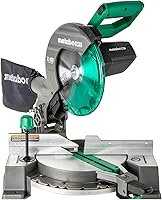
How to Use a Sliding Compound Miter Saw
To use a sliding compound miter saw, set your miter and bevel angles, press the workpiece flat against the fence, then pull the head fully out before lowering the blade and pushing it back through the cut. The slide lets you crosscut boards wider than a non-sliding saw can handle.
On this page (8 sections)
- What do you check before the first cut?
- How do you set the miter and bevel angles?
- How do you make a straight crosscut with the slide?
- How do you cut wide boards and thick stock?
- How do you make angled and compound cuts?
- How do you stay safe while using the saw?
- Which saw suits a first-time user?
- How do you get clean, repeatable cuts?
To use a sliding compound miter saw, set the miter and bevel angles, press the board flat against the fence, pull the head fully out, start the saw, then push the blade down and back through the wood. The slide is the part that separates it from a plain miter saw, and using it in the right order is what keeps cuts straight and safe.
If you're still deciding on a saw, our guide to what a sliding compound miter saw is covers the layout and the rail system. This post picks up from there and walks through the actual use.
What do you check before the first cut?
Clear the work area, check the blade and the fence, and confirm the saw sits on a stable bench before you plug it in. A sliding saw is heavier than a fixed one, so a wobbling table shows up as a crooked cut.
Look at the blade for missing teeth or pitch buildup, and make sure the guards move freely. The WEN MM1015 ships with a 40-tooth carbide-tipped blade with a 5/8-inch arbor, which is a general-purpose blade rather than a fine trim blade.
Check that the fence halves are square to the table and that the miter lock holds at 0 degrees. Spin the blade by hand with the saw off to confirm it clears the table slot through the full slide.
Long stock that sags off the table will rock during the cut and bind the blade, so set the saw where the board is supported on both sides.
How do you set the miter and bevel angles?
Miter rotates the table; bevel tilts the head. Turn the table to your angle and lock it, then set the bevel only if you need a cut through the edge of the board.
The WEN MM1015 has 9 miter stops: two each at 15, 22.5, 31.6 and 45 degrees, plus one at 0. Its miter lock also lets you set any angle between those stops.
Bevel goes to 45 degrees in either direction on the dual-bevel models here. A dual-bevel saw lets you tilt the head toward or away from the fence, so you don't have to flip the board for a matching cut on the other face.
The Ridgid R4210 widens this with a 0 to 70 degree miter range to the left and right, which helps with steep trim angles that stop short on a 45 or 49 degree saw.
Lock every adjustment before the blade spins. A table or head that drifts mid-cut leaves a stepped edge that's hard to fix.
How do you make a straight crosscut with the slide?
Pull the head out, start the motor, lower the blade into the front edge, then push back through the board. This is the core move for how to use a sliding compound miter saw on square cuts.
- Set the miter to 0 degrees and lock it, with the bevel at 0.
- Mark the cut line and align it with the blade or the LED cutline.
- Hold or clamp the board flat against the fence.
- Pull the head toward you until the blade clears the front edge.
- Start the saw and let it reach full speed.
- Lower the head, then push the blade away from you through the wood.
- Release the trigger, wait for the blade to stop, then raise the head.
The pull-out, push-through order matters because the blade teeth cut into the face of the board on the push. Pushing into a board that hasn't been cleared by the slide can grab and kick.
The LED cutline guide on the WEN MM1015 casts a shadow against the blade to show the line of cut. The Ridgid R4210 uses an LED cut line plus a work light.
Use either to line up the mark, then confirm with a test cut on scrap.
How do you cut wide boards and thick stock?
Use the full slide for boards wider than the blade's diameter, which is the main reason to own this saw type. A 10-inch sliding saw can crosscut stock a fixed 10-inch saw cannot.
The WEN MM1015 crosscuts boards up to 12 inches wide and 3.75 inches thick at a straight cut. That covers most decking, shelving and wide trim, though you'll still need to check each board against the stated capacity.
For thick stock, make sure the blade clears the full depth and the head doesn't hit the clamp. Raise the clamp or move it to the other side of the cut if it fouls the slide.
Keep your supporting hand outside the blade path and let the head do the work. Forcing a wide cut is the usual cause of a burned edge and a blade that wanders off the line.
Where does a better blade help?
A fine 60-tooth blade gives smoother trim cuts than the 40-tooth blade most saws ship with. The Freud LU91M010 is a 10-inch, 60-tooth thin-kerf blade built for sliding compound miter saws.
Its 5/8-inch arbor fits the WEN MM1015 and the Ridgid R4210. The negative hook angle and thin 0.090-inch kerf matter here, since the blade is less likely to climb through the cut.
Swap to this blade for baseboard, casing and other visible trim. Keep the stock blade for rough framing and painted lumber where speed matters more than the finish.
How do you make angled and compound cuts?
Set the miter for the angle across the board, and add a bevel when the cut also needs to tilt through the edge. A cut with both angles set is a compound cut.
For a simple miter on baseboard or casing, turn the table to the angle and leave the bevel at 0. For crown molding laid flat, you set both the miter and the bevel to match the spring angle.
The WEN MM1015 makes compound cuts in boards up to 8.5 inches wide and 2.6 inches thick when both angles are at 45 degrees. That's narrower than its straight crosscut capacity, so plan wide crown cuts around that limit.
Test the setup on scrap before cutting finished material. A test cut catches an angle error while the board is still cheap.
How do you cut crown molding flat?
Lay the molding flat and use the miter and bevel angles printed on the saw's crown chart, or nest it against the fence with a crown stop. Flat cutting is easier to repeat and needs less setup.
The Ridgid R4210 has crown stop mounting holes for common stops and Ridgid's own crown molding stops. The WEN MM1015 lists a 5.5-inch crown molding nested capacity and a 3.5-inch baseboard vertical capacity.
Nested cutting means the molding sits at its real wall angle against the fence. A crown stop holds it there so your hands stay clear of the blade.
Cut a pair of test pieces for each corner and label each piece as you cut it, since inside and outside corners need opposite angles.
How do you stay safe while using the saw?
Keep both hands clear of the blade path, clamp the work when you can, and never reach across a spinning blade. Safety comes down to a few habits repeated on every cut.
Let the blade reach full speed before it touches wood, and wait for it to stop before lifting the head. Reaching in early is how most miter saw injuries happen.
Wear eye protection and keep sleeves and loose items away from the blade. The dust port on these saws takes a bag or a shop vacuum, and clearing chips as you go keeps the cut line visible.
Don't cut warped or unsupported boards that can shift during the slide. If a board rocks when you press it flat, it isn't ready to cut.
Which saw suits a first-time user?
The Ridgid R4210 suits a first-time user who wants a wide miter range and dual-bevel cuts, while the WEN MM1015 is the more budget-minded option with the same core features.
The Ridgid R4210 has a 15-amp motor, a 0 to 70 degree miter range, dual-bevel design, LED cut line and work light, and crown stop mounting holes. Those extras help when you cut crown molding and steep trim angles.
The WEN MM1015 has a 15-amp motor, a 12-inch crosscut capacity, a 49 degree miter range in either direction, 9 miter stops, dual-bevel capability and an LED cutline guide. It's a sensible first sliding saw for general cutting and shelving.
Compare these against fixed-head options in our sliding vs compound miter saw breakdown before you decide. If you're also weighing a basic saw, our miter saw vs compound miter saw comparison explains what each type can and can't do.
For more models, browse the best compound miter saws roundup.
How do you get clean, repeatable cuts?
Use a sharp fine-tooth blade, hold the board flat against the fence, and let the blade do the cutting instead of forcing it. Repeatable results come from the setup, not from pushing harder.
For repeated parts, set a stop block against the fence so each piece lands at the same length. Measure once, clamp the stop, and cut the rest without re-measuring.
Let the blade stop fully between cuts and brush chips away from the fence. Sawdust under the board tilts it slightly and shows up as an uneven edge.
Recheck the miter and bevel locks after a few cuts. A lock that works loose slowly shifts the angle, and you'll only notice when two pieces stop meeting cleanly.
Start with square crosscuts on scrap until the pull-out and push-through motion feels normal. Then set a miter angle and practice matching cuts before moving on to compound work.
Pick the Ridgid R4210 for wide-angle and crown work, or the WEN MM1015 for general cutting on a tighter budget.
Frequently asked questions
Do I push or pull a sliding miter saw to cut?
Pull the head fully toward you first, start the saw, then push the blade away from you through the wood. This pull-out, push-through order keeps the blade from grabbing and lets the teeth cut into the face of the board.
How wide a board will a sliding miter saw cut?
It depends on the model. A 10-inch sliding saw such as the WEN MM1015 crosscuts boards up to 12 inches wide and 3.75 inches thick at a straight 0-degree cut.
Check your saw's stated crosscut capacity before buying wide stock.
What is the difference between miter and bevel on a miter saw?
Miter turns the table left or right for angled cuts across the board. Bevel tilts the blade head left or right for angled cuts through the edge.
Setting both at once gives a compound cut, which is how you cut crown molding flat.
Do I need to clamp the wood on a sliding miter saw?
Yes, whenever the cut allows it. A clamp or quick-clamp holds the board flat against the fence so it cannot creep during the slide.
Keep your hands at least a blade's width clear of the cut line and let the blade stop before lifting it.
Why does my sliding miter saw leave a rough edge?
A dull or low-tooth blade, a fast push, or a board that shifts against the fence usually cause tear-out. Use a sharp fine-tooth blade for trim, hold the wood flat, and let the blade reach full speed before it enters the cut.