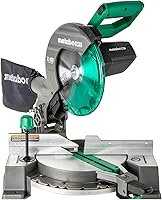
Sliding vs Compound Miter Saws: Which to Buy? (October 2026)
Choose a sliding miter saw for wider boards and a standard compound saw for narrower cuts. The sliding vs compound miter saw choice comes down to your stock, work space and how often you bevel.
On this page (9 sections)
- Sliding vs compound miter saw: what does each type do?
- Which saw cuts wider boards?
- How much room does a sliding miter saw need?
- Is single or dual bevel better for your work?
- What helps you set angles and repeat cuts?
- How should you set up and care for a miter saw?
- Who should buy each type?
- What mistakes should you avoid before buying?
- Sliding vs compound miter saw: which should you choose?
For sliding vs compound miter saws, choose a slider for wider boards and a standard compound saw for narrower stock. The right fit depends on your usual material, available bench space and how often you make bevel cuts.
A sliding saw moves the blade head forward and back to cut wider material. A compound saw tilts the blade to make bevel cuts.
A saw can combine both features, which is why some models are sliding compound saws.
The DeWalt DWS713 is a single-bevel compound saw, while the Skil MS6305-00 and Bosch CM10GD add sliding or glide action and dual bevels. The comparison below focuses on what those differences mean for your work.
 Best for wide boards
Skil MS6305-00 10-Inch Dual-Bevel Sliding Miter Saw
 Best for shallow work spaces
Bosch CM10GD 10-Inch Dual-Bevel Glide Miter Saw
Sliding vs compound miter saw: what does each type do?
Sliding describes the blade's travel, while compound describes its ability to bevel. A sliding compound saw combines both, giving you wider crosscuts and angled cuts.
On a sliding saw, the blade assembly travels along rails or a glide mechanism. That movement lets the blade reach across a wider board than a similar saw whose head only pivots down.
A compound saw tilts the blade to make a bevel cut. Set a miter angle at the same time and you can cut a compound angle, such as one used to fit crown molding.
The guide to miter cuts and bevel cuts explains how those angles differ. For a closer look at the sliding design, read what a sliding compound miter saw is.
How do you choose a sliding vs compound miter saw?
Start with the widest board you expect to cut and the angles you make most. If the board exceeds a standard saw's capacity, look at sliding models and compare their stated capacity at your intended angle.
Then consider workspace and bevel direction. A slider often needs room behind the saw, while dual bevel lets you tilt in both directions without turning the board around.
If your projects mostly involve narrow trim and square crosscuts, a standard compound saw may be enough. For trim corners, our guide to cutting compound angles shows how the two angle settings work together.
Which saw cuts wider boards?
A sliding saw suits projects with wide boards, but the exact cut capacity varies by model and angle. Check the stated capacity for the cuts you plan to make.
The Skil MS6305-00 crosscuts lumber up to 2x12 at 90 degrees and 2x8 at 45 degrees. Those limits make it a practical option when wider stock is a regular part of your work.
The DeWalt DWS713 crosscuts 2x6 dimensional lumber at 90 degrees and 2x4 at 45 degrees. It can suit trim and narrower boards, but its capacity may require a different saw for wider stock.
Bosch gives the CM10GD a 12 in horizontal cut capacity. Its Axial-Glide hinge arms reduce the front-to-back footprint by up to 10 in compared with slide saws with similar capacities.
How much cutting capacity do your projects need?
Measure the widest board you expect to cut, and allow for future projects only if you have a clear use for the added capacity. A 90-degree rating does not guarantee the same cut at 45 degrees.
For framing stock, confirm both the board dimensions and the cut angle before choosing a saw. Our guide to whether a miter saw can cut a 4x4 covers a common capacity question.
How much room does a sliding miter saw need?
A rail-style slider needs depth behind it for the saw head to travel. Measure the saw in its operating position, not only where it sits when stored.
A saw that fits on a bench may need more clearance when you pull the head forward to make a cut. Leave room for the board to extend on either side as well, especially when cutting long stock.
The Bosch CM10GD uses articulated hinge arms instead of side slide rails. Bosch says that design reduces front-to-back space by up to 10 in compared with slide saws with similar capacities.
Before buying, measure from the rear of the saw to the nearest wall and account for the full travel of its mechanism. Also check the saw's weight if you expect to move it between a bench and storage.
Is single or dual bevel better for your work?
Choose dual bevel if you often make bevel cuts in both directions. It lets you tilt the head left or right instead of flipping the workpiece to change the direction of the bevel.
The Skil MS6305-00 has positive bevel stops at 48 and 45 degrees left, 0 degrees and 45 degrees right. The Bosch CM10GD bevels up to 47 degrees in either direction and has detents at common angles, including 0, 33.9 and 45 degrees.
The DeWalt DWS713 is single bevel, with a range from 0 to 48 degrees left and 0 to 3 degrees right. That may be sufficient when most cuts are square or you bevel in one direction.
A single-bevel saw can suit occasional angled work, especially if you don't mind turning the board when you need the opposite bevel. If you make repeated trim cuts that alternate direction, dual bevel can reduce repositioning.
What helps you set angles and repeat cuts?
Clear stops and controls help you return to common angles. Choose a saw whose stops match the cuts you make often, and secure the stock before each cut.
The Skil has positive stops at common miter angles and cuts up to 50 degrees left and right. The DeWalt has a stainless-steel miter detent plate with 14 positive stops.
The Bosch has adjustable miter detents at common angles and a push-button override for fine adjustments. Its bevel lock lever and range selector are at the front, so you don't need to reach behind the saw to set a bevel.
For repeat cuts, use the same angle setting, support the workpiece, and confirm the first cut before making a batch. A stop helps return to a setting, but it doesn't replace checking that the material sits flat against the fence.
How should you set up and care for a miter saw?
Set the saw on a stable, level surface with room for the head and stock to move. A careful setup makes it easier to keep the workpiece supported and your hands clear of the blade path.
Before cutting, secure the saw to its stand or bench according to its instructions. Use the fence and clamp to hold the workpiece in place, and keep long boards supported so they don't tip or bind during a cut.
Unplug a corded saw before changing the blade or clearing packed sawdust. Keep the work area clear, check that the blade is secure, and follow the manual for cleaning, adjustments and any service needs.
Avoid forcing the blade through stock or starting a cut before the blade reaches speed. Let the blade stop before lifting the head, and don't reach into the cutting area while it is moving.
Who should buy each type?
Buy a standard compound saw for narrower stock and a slider for wider crosscuts. The Bosch glide design is a fit when you need wide cuts but have limited depth behind the saw.
The DeWalt DWS713 suits trim work and stock within its 2x6 capacity at 90 degrees. Its single bevel works for buyers who make occasional bevel cuts and want a saw without sliding travel.
The Skil MS6305-00 suits projects that need wide crosscuts and bevels in both directions. Its 2x12 capacity at 90 degrees gives it room for stock beyond the DeWalt's stated capacity.
The Bosch CM10GD fits buyers who want a 12 in horizontal cut capacity and less front-to-back space than similar-capacity slide saws. At 64 lb, it may be a poor fit if you need to carry the saw often.
Skip a slider if your stock is consistently narrow and you have no use for the extra reach. Skip a single-bevel saw if frequent bevel cuts in both directions would make flipping the board a nuisance.
For the broader range of designs, see compound miter saw types and sizes. If you know you need a slider, compare more options in our sliding miter saw guide.
What mistakes should you avoid before buying?
Don't choose by blade size or the word “compound” alone. Those labels don't tell you whether a saw can crosscut your stock or fit your workspace.
First, don't assume that two 10 in saws have the same capacity. Compare the model's rated width at both 90 and 45 degrees, and use the rating that matches your intended cut.
Second, don't treat dual bevel as a substitute for sliding capacity. Dual bevel changes the direction the blade tilts; it doesn't by itself let the saw reach across a wider board.
Finally, don't measure only the saw's parked footprint. Include the slide or glide mechanism's travel, the board's overhang and the space needed to support material safely.
Sliding vs compound miter saw: which should you choose?
Pick a slider for wider boards, a standard compound saw for narrower stock, and a glide design when rear clearance is tight. Add dual bevel when you often cut angles in both directions.
The Skil MS6305-00 is the clear fit for wide crosscuts and dual-bevel work. The DeWalt DWS713 suits narrower cuts and trim, while the Bosch CM10GD pairs wide capacity with a mechanism designed to use less front-to-back space than similar-capacity slide saws.
For a wider comparison of saw styles and tradeoffs, read miter saw vs compound miter saw.
Frequently asked questions
What is the main difference between a sliding and compound miter saw?
A sliding miter saw moves its blade assembly along rails, which lets it crosscut wider boards. A compound saw tilts its blade for bevel cuts, but may have a narrower capacity if it does not slide.
Some saws combine both features.
Check the capacity for the material you plan to cut.
Can a compound miter saw cut wide boards?
It can cut boards within its stated crosscut capacity. The DeWalt DWS713 is rated for a 2x6 crosscut at 90 degrees, while the Skil MS6305-00 is rated for a 2x12 crosscut at 90 degrees.
Use the exact model's capacity when sizing stock.
Does a sliding miter saw need extra space?
Rail-style sliding saws need room for the slide mechanism behind the saw as the head moves. Measure the available depth with the saw in its operating position.
Bosch's Axial-Glide uses articulated hinge arms and reduces front-to-back space compared with similar-capacity slide saws.
Is dual bevel worth it on a miter saw?
Dual bevel is useful when you make angled cuts in both directions, since you can tilt the head left or right instead of flipping the board. For occasional bevels in one direction, a single-bevel saw may be enough.
Which saw should a beginner choose?
Choose by the widest board and most complex angle you expect to cut, then consider storage and setup space. A standard compound saw can suit narrower trim work, while a sliding model offers more crosscut capacity.
Read our miter saw buying guide before deciding.