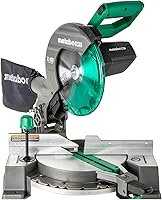
8 Best Compound Miter Saws (October 2026)
The best compound miter saws include the DeWalt DWS715 12-Inch Single-Bevel Compound Miter Saw for taller trim, the Metabo HPT C10FCG2 10-Inch Compound Miter Saw for mobile trim crews, and the DeWalt DWS716 12-Inch Double-Bevel Compound Miter Saw for mirrored bevels.
On this page (4 sections)
The best compound miter saw for most buyers is the DeWalt DWS715, with a 12-inch blade, positive angle stops and a tall sliding fence. Choose the Metabo HPT C10FCG2 for a lighter 10-inch saw, or the DeWalt DWS716 if you make bevel cuts in both directions.
The right saw depends on what you cut, how often you move your tools and whether your projects call for bevels, miters or both. This guide compares eight compound miter saws by their stated capacities, angle ranges, fence support and alignment features.
If you are comparing saw types, start with compound miter saw sizes, types and picks. For a closer look at fixed-head and sliding designs, see sliding vs compound miter saws.
Our picks at a glance
-
1
 Best for taller trim
DeWalt DWS715 12-Inch Single-Bevel Compound Miter Saw
9.1/10 our score
See it on Amazon -
2
 Best for mobile trim crews
Metabo HPT C10FCG2 10-Inch Compound Miter Saw
9.0/10 our score
See it on Amazon -
3
 Best for mirrored bevels
DeWalt DWS716 12-Inch Double-Bevel Compound Miter Saw
8.8/10 our score
See it on Amazon
- 4
 Check it
DeWalt DWS713 10-Inch Single-Bevel Compound Miter Saw
Best for routine trim - 5
 Check it
DeWalt DWS716XPS 12-Inch Double-Bevel Miter Saw
Best for marked cutlines - 6
 Check it
Makita LS1040 10-Inch Compound Miter Saw
Best for right-side angles - 7
 Check it
Genesis GMS1015LC 10-Inch Compound Miter Saw with Laser
Best for laser alignment - 8
 Check it
Ryobi 10-Inch Compound Miter Saw with LED
Best for corded DIY shops
Which compound miter saw fits each kind of work?
The DeWalt DWS715 is the most capable general-purpose pick in this group for buyers who need taller trim support. The other saws earn their place through lower carrying weight, a double-bevel head, a special angle range or a visible cutline.
| Product | Best for | Blade | Bevel | Miter stops | Our score |
|---|---|---|---|---|---|
| DeWalt DWS715 12-Inch Single-Bevel Compound Miter Saw | taller trim | 12 in | 0–48° left, 0–3° right | 14 positive stops | 9.1 |
| Metabo HPT C10FCG2 10-Inch Compound Miter Saw | mobile trim crews | 10 in | 9.0 | ||
| DeWalt DWS716 12-Inch Double-Bevel Compound Miter Saw | mirrored bevels | 12 in | 0–48° left and right | 8.8 | |
| DeWalt DWS713 10-Inch Single-Bevel Compound Miter Saw | routine trim | 10 in | 0–48° left, 0–3° right | 14 positive stops | 8.5 |
| DeWalt DWS716XPS 12-Inch Double-Bevel Miter Saw | marked cutlines | 12 in | 0–48° left and right | 8.3 | |
| Makita LS1040 10-Inch Compound Miter Saw | right-side angles | 10 in | Up to 45° left | 7.8 | |
| Genesis GMS1015LC 10-Inch Compound Miter Saw with Laser | laser alignment | 10 in | Nine positive stops | 7.1 | |
| Ryobi 10-Inch Compound Miter Saw with LED | corded DIY shops | 10 in | 7.0 |
DeWalt DWS715 12-Inch Single-Bevel Compound Miter Saw: Best for taller trim
- 12-inch blade
- 14 positive miter stops
- Tall sliding fence supports 5-1/2-inch base vertically
- Bevels left and right
The 12-inch blade and tall sliding fence suit buyers who need more vertical base molding support. Its positive stops help set common miter angles.
Pros
- 12-inch blade
- Tall fence supports 5-1/2-inch base vertically
- 14 positive miter stops
Cons
- Single bevel design
- Right bevel range is limited to 3°
The DWS715 suits trim work that benefits from a larger blade and taller fence support. The fence supports base molding up to 5-1/2 inches vertically, and the saw can crosscut 2-by-8 dimensional lumber at 90 degrees.
Its 14 positive miter stops make common angle settings easier to repeat. The saw bevels up to 48 degrees left but only 3 degrees right, so skip it if your projects need substantial right-side bevels.
This is a single-bevel saw. When you need matching bevels in opposite directions, you may need to turn the workpiece or choose a double-bevel model.
Choose it for taller base molding and larger crosscuts. If your stock fits a 10-inch saw and you need an easier carry, the Metabo HPT is a lighter option.
Metabo HPT C10FCG2 10-Inch Compound Miter Saw: Best for mobile trim crews
- 10-inch blade
- 24.2 lb weight
- Miter range 0–52° left and right
- Bevel range 0–45° left
Its stated 24.2 lb weight makes this the lightest option here with a published weight. The broad miter range covers many common angle settings.
Pros
- 24.2 lb weight
- Miter range reaches 52° both ways
- Vice clamp secures the workpiece
Cons
- Single bevel design
- Bevels left only
The Metabo HPT C10FCG2 is the portable choice for small shops or job sites where you move the saw often. Its stated weight is 24.2 lb, and its large table and vice clamp help support and secure the workpiece.
The miter range reaches 52 degrees to either side, while the bevel tilts up to 45 degrees left. That gives you useful angle flexibility in a 10-inch saw, but the head does not bevel right.
Choose this model when your stock fits its capacity and you want a lighter machine for trim or general woodworking. Skip it if your routine calls for right-side bevels or the larger capacity of a 12-inch saw.
Choose it for portable 10-inch work and wide miter settings. Read our 10-inch compound miter saw size guide to compare the blade size with your typical stock.
DeWalt DWS716 12-Inch Double-Bevel Compound Miter Saw: Best for mirrored bevels
- 12-inch blade
- Double bevels 0–48° both ways
- 14 positive miter stops
- Fence supports 6-1/2-inch base vertically
The head tilts both ways, so you can make matching bevels without turning the workpiece around. Its tall fence supports larger trim.
Pros
- Double bevels in both directions
- 14 positive miter stops
- Fence supports 6-1/2-inch base vertically
Cons
- Heavier than the 10-inch options
- No cutline indicator specified
The DWS716 is the right choice here when repeated bevel cuts in both directions are part of the work. Its head tilts up to 48 degrees left and right, which lets you cut mirrored bevels without turning the board around.
The sliding fences support base molding up to 6-1/2 inches vertically and crown molding up to 6-5/8 inches nested. It also has a 12-inch blade, positive angle stops and miter capacity up to 50 degrees on either side.
At 48.3 lb, this saw is considerably heavier than the Metabo HPT. Choose it for a workshop or a setup that stays in one place, and skip it if low carrying weight matters more than double bevel.
Choose it for frequent mirrored bevels and taller trim. Our guide to miter cuts vs bevel cuts explains which angle each cut changes.
DeWalt DWS713 10-Inch Single-Bevel Compound Miter Saw: Best for routine trim
- 10-inch blade
- 15-amp motor
- 14 positive miter stops
- Fence supports 4-1/4-inch base vertically
This 10-inch saw is aimed at routine cuts where double bevel is not a requirement. Its fence and positive stops fit common trim work.
Pros
- 14 positive miter stops
- 15-amp motor
- Built-in carry handle
Cons
- Single bevel design
- Less vertical base support than the 12-inch DeWalt
The DWS713 fits routine trim and shop work when a 10-inch blade meets your capacity needs. Its fence supports 4-1/4-inch base vertically, and its 14 positive stops help you return to common miter settings.
It can crosscut 2-by-6 dimensional lumber at 90 degrees and 2-by-4 lumber at 45 degrees. The saw bevels up to 48 degrees left and 3 degrees right, so it is a poor fit for projects that need a broad right bevel.
This is a single-bevel model without the taller fence support of the DWS715. Choose it for smaller stock and straightforward cuts, or skip it if you regularly cut taller molding or need double bevel.
Choose it for everyday cuts in smaller trim. If you are unsure about the blade size, use our guide to whether a 10-inch compound saw is big enough.
DeWalt DWS716XPS 12-Inch Double-Bevel Miter Saw: Best for marked cutlines
- 12-inch blade
- Double bevels 0–48° both ways
- Integrated CUTLINE LED work light
- 14 positive miter stops
This double-bevel saw adds an integrated CUTLINE LED work light to indicate the cutline. It shares the broad angle ranges and tall fence of the DWS716.
Pros
- Integrated cutline indicator
- Double bevels in both directions
- 12-inch blade
Cons
- Heavier than the 10-inch options
The DWS716XPS suits buyers who want a visible cutline as well as a double-bevel head. Its integrated CUTLINE LED work light indicates the blade position, while the head tilts both left and right for matching bevel cuts.
It shares the DWS716's 14 positive miter stops, miter capacity up to 50 degrees in either direction, and fence support for tall base and nested crown molding. Pick this model when the indicator is useful in your work area.
Skip it if you will not use the cutline indicator or if weight is a major concern. The regular DWS716 has the same double-bevel function and fence support without the stated CUTLINE feature.
Choose it for a marked cutline and double-bevel work. Learn more about whether a miter saw laser guide is worth having.
Makita LS1040 10-Inch Compound Miter Saw: Best for right-side angles
- 10-inch blade
- Miter range reaches 52° right
- Bevels up to 45° left
- Nine positive miter stops
The LS1040 offers extra right-side miter range in a 10-inch saw. Its direct-drive motor and positive stops suit common shop and trim cuts.
Pros
- Miter range reaches 52° right
- Nine positive stops
- Direct-drive motor
Cons
- Bevels left only
- Miter range differs by direction
The Makita LS1040 is a good match for a 10-inch saw that needs more miter travel to the right. It reaches 52 degrees right and 45 degrees left, with nine positive stops for common settings.
Its bevel tilts up to 45 degrees left, and its direct-drive motor is rated at 15 amps. The one-way bevel and different miter ranges are tradeoffs, so check your planned angles before buying.
Choose it if right-side miters come up often and your stock fits a 10-inch saw. Skip it if you need equal miter travel in both directions or want to tilt the blade either way.
Choose it for right-side miter cuts in a compact shop. For boards wider than the saw's fixed cutting path, compare the best sliding miter saws.
Genesis GMS1015LC 10-Inch Compound Miter Saw with Laser: Best for laser alignment
- 10-inch blade
- Integrated laser guide
- Nine positive miter stops
- Electric brake
The built-in laser helps show the cut position before you lower the blade. Positive stops cover commonly used miter angles.
Pros
- Integrated laser guide
- Electric brake
- Includes extension wings and hold-down clamp
Cons
- Bevels left only
- Maximum cut capacity at 45° by 45° is 1-3/8 by 3-5/16 inches
The Genesis GMS1015LC is the pick for buyers who want an integrated laser guide on a 10-inch saw. It also includes extension wings and a hold-down clamp, which help support and secure stock.
The saw bevels up to 45 degrees left and has nine positive miter stops. At a 45-degree miter and bevel, its maximum cut capacity is 1-3/8 by 3-5/16 inches, so compare that limit with your angled pieces.
Choose it when the laser and common stops suit your work. Skip it if your projects need a broad bevel range to the right or a larger compound cut at 45 degrees.
Choose it for laser alignment on common cuts. If you prefer an LED cutline or want to compare guide types, see our miter saw laser guide article.
Ryobi 10-Inch Compound Miter Saw with LED: Best for corded DIY shops
- 10-inch blade
- LED cutline indicator
- 24-tooth carbide-tipped blade
- Corded electric
The LED cutline indicator helps with blade alignment, and the saw includes a carbide-tipped blade and work clamp. Confirm its angle and capacity details before buying for a specific cut.
Pros
- LED cutline indicator
- Corded electric power
- Work clamp included
Cons
- Miter and bevel ranges are not specified
- Comes with a 24-tooth blade
The Ryobi 10-inch saw suits a corded DIY shop where an LED cutline indicator is useful. It comes with a work clamp and a 24-tooth carbide-tipped blade.
Its stated speed is up to 5,500 RPM, but the available specifications do not state its miter range, bevel range or cut capacity. Confirm those details before buying it for a project with exact angle or stock requirements.
Choose it for general cuts only after checking that its capacity matches your work. Skip it if you need published angle ranges to compare models or make precise compound cuts for built-ins and trim.
Choose it for an LED indicator in a corded home shop. Blade tooth count affects how a blade suits different cuts; our miter saw blade teeth guide explains what to consider.
How do you choose the best compound miter saw?
Choose the best compound miter saw by matching its stated capacity, bevel direction and miter range to the cuts you make most. Then weigh portability, setup space and cutline aids against how often those features will help.
Is a 10-inch or 12-inch compound miter saw better?
A 10-inch saw can be enough for routine trim and smaller stock, while a 12-inch model may handle taller or larger pieces. The useful comparison is the actual capacity of each saw, not blade size by itself.
For example, the DWS713 is rated for a 2-by-6 crosscut at 90 degrees, while the DWS715 is rated for a 2-by-8 crosscut at the same angle. Check your material dimensions and the fence support before choosing a model for molding.
A larger saw also needs a suitable bench and room to operate safely. If your stock is narrow and your work area is limited, a 10-inch model may be easier to place and carry.
When should you pay more attention to bevel range?
Bevel range matters when you need the blade to tilt while making a miter, such as for compound molding joints. A single-bevel saw can make these cuts, but you may need to turn the material to create a matching angle on the opposite side.
A double-bevel saw tilts left and right. It saves repositioning when you repeat mirrored cuts, but adds weight and may be unnecessary if most of your work uses square cuts or one bevel direction.
Check the actual range in both directions. Some single-bevel saws have very limited right-side tilt, while others only tilt one way.
When is a sliding saw a better choice?
A sliding saw is worth comparing when your boards are wider than the fixed cutting path can handle. Its rails let the blade travel across the material, which adds crosscut reach but usually calls for more rear clearance.
Measure the widest stock you expect to cut and compare it with each saw's published capacity. See what a sliding compound miter saw is if you want to understand the mechanism before comparing models.
Do you need a laser or LED cutline?
A laser or LED cutline can help you align the blade with a pencil mark before the cut. These aids are useful when you make repeated trim cuts or work in a space where the cutline is hard to see.
They do not replace checking the blade against the mark or making a careful setup. The Genesis has an integrated laser, while the DWS716XPS and Ryobi include LED cutline features.
What should you check before buying?
Start with your stock size, the angles you use and whether the saw must move between locations. Check whether a model's fence supports the height of your molding and whether its bevel tilts in the direction your cuts require.
For a useful shortlist, choose one model with enough capacity, then compare portability and convenience features. A clamp, positive stops and a clear cutline can simplify repeated work, but none can compensate for a saw that is too small for the material.
How should you set up and use a compound miter saw?
Set the saw on a stable surface, support long stock and confirm that the material sits flat against the fence before cutting. A careful setup helps the angle and cutline matter as intended.
Before the first cut, read the saw's manual and check the blade, fence and table for alignment. Secure the saw to its stand or work surface as directed, keep the area clear and make sure the blade can travel without striking a clamp or support.
Support long boards at the same height as the saw table so the stock does not sag or twist. Position the workpiece firmly against the fence, then use the clamp where supplied and appropriate for the cut.
For an unfamiliar angle, make a practice cut in scrap first. Check how the pieces meet, adjust the setting if needed, and only then cut the finished material.
What common mistakes lead to poor cuts?
A common mistake is choosing a saw by blade size alone. The fence, published cut capacity and angle range are just as important when your projects use tall molding or angled joints.
Another mistake is relying on the miter detent without checking how the finished joint fits. Positive stops help you set common angles quickly, but material and setup still affect the result; a scrap piece gives you a low-cost way to check the fit.
Avoid letting stock shift during the cut or supporting a long board at the wrong height. Keep hands clear of the blade path, use the work clamp as directed and wait for the blade to stop before clearing offcuts.
How do you care for a compound miter saw?
Keep the table and fence clear of sawdust, and follow the manual's instructions for cleaning, blade changes and adjustment. A clean contact surface helps the stock sit flat and makes angle settings easier to check.
Inspect the blade before work and replace it when it is damaged or no longer suits the cut. Keep guards and clamps in place, and store the saw where it will not be exposed to damage or damp conditions.
A dull or unsuitable blade can make a clean cut harder to achieve. Compare tooth count and blade type with the material; our miter saw blade teeth guide covers the basics.
Which compound miter saw should you buy?
Choose the DeWalt DWS715 for taller base molding and the larger stated 90-degree crosscut capacity. Pick the Metabo HPT C10FCG2 if portability and broad miter travel matter more than a 12-inch blade.
Choose the DeWalt DWS716 for regular bevels in both directions, or the DWS716XPS when its cutline indicator will help your workflow. For routine 10-inch cuts, consider the DWS713; choose the Genesis for a laser guide and the Makita for extra right-side miter range.
If your boards exceed the capacity of a fixed-head compound saw, compare a sliding model before buying. The best compound miter saw is the one whose capacity and angle range fit your actual stock and cuts.
Our top 3 picks at a glance
-
1
Best for taller trim
DeWalt DWS715 12-Inch Single-Bevel Compound Miter Saw
9.1/10 our score
See it on Amazon -
2
Best for mobile trim crews
Metabo HPT C10FCG2 10-Inch Compound Miter Saw
9.0/10 our score
See it on Amazon -
3
Best for mirrored bevels
DeWalt DWS716 12-Inch Double-Bevel Compound Miter Saw
8.8/10 our score
See it on Amazon
Frequently asked questions
What is the best compound miter saw for most people?
The DeWalt DWS715 is a strong general choice if you want a 12-inch blade, positive miter stops and a tall fence that supports 5-1/2-inch base vertically. Choose a 10-inch model when its capacity fits your stock, or a double-bevel saw when you make matching bevels often.
Should I buy a 10-inch or 12-inch compound miter saw?
A 10-inch saw can suit routine trim and shop cuts, while a 12-inch model may offer more capacity. Compare the stated cut capacity and fence support with your stock, then consider how much space the saw takes and whether you'll need to move it.
Is a double-bevel miter saw worth it?
A double-bevel saw tilts left and right, which can save you from turning the workpiece for matching bevels on opposite sides. A single-bevel model can be enough when most cuts use one direction or you are comfortable repositioning the material.
Can a compound miter saw cut wide boards?
A standard compound saw has a fixed cutting path, so crosscut capacity depends on its blade size and design. Compare the saw's stated capacity with your board dimensions before you buy.
If you regularly cut wider stock, compare a sliding compound saw, which moves the blade across the work.