How High Should a Miter Saw Table Be?
Aim for a miter saw table height that puts the saw's cutting surface about 36 to 39 inches off the floor. A simpler check is your own body: stand beside the saw and the table top should land near your elbow, so you can press down and swing the head without bending your back.
On this page (10 sections)
- What is the standard height for a miter saw table?
- How do you measure your own ideal table height?
- What changes the number for a sliding or compound saw?
- Should the table match a workbench or a dedicated saw stand?
- How do you set the height when building your own table?
- How much space around the table matters as much as height?
- Which saws fit a table at the elbow-height range?
- How do you fix a table that feels too high or too low?
- What else should you check once the height is set?
- How high should a miter saw table be for most people?
Aim for a miter saw table height that puts the saw's cutting surface about 36 to 39 inches off the floor. A simpler check is your own body: stand beside the saw and the table top should land near your elbow, so you can press down and swing the head without bending your back.
The right figure is less about a single number than about matching the bench to your reach. A short bench forces you to stoop over every cut, and a tall one pushes your shoulders up and makes the saw feel top-heavy.
This guide shows how to measure your own sweet spot and build or adjust a table to hit it.
What is the standard height for a miter saw table?
Most shop benches and miter saw stands land between 36 and 39 inches at the cutting surface. That range suits a broad span of adult heights and keeps the saw at a level where your arm can drive the head down with steady pressure.
Saw stands are built to sit in roughly this band, because a bench that's too low tires your lower back across a long run of cuts. A benchtop saw's base adds a few inches to whatever top you set it on, so the number you care about is the top of the saw's table, not the top of the bench underneath it.
That distinction matters when you build your own bench. If the saw base is 3 inches thick, a 33-inch bench top puts the cutting surface at about 36 inches.
Measure the base height first, then subtract it from your target to find the bench top height you need.
How do you measure your own ideal table height?
Stand at the saw with your feet flat and let your elbow set the target. Bend your arm to about a right angle and note where your forearm or elbow falls; that point is your cutting surface height.
This works because the saw head is driven down from above. When the handle sits near your elbow, your arm can push straight down with your body weight rather than your shoulder muscles.
A handle that's too low makes you lean forward; one that's too high makes you lift and reach.
Measure in the shoes you actually wear in the shop. A thick-soled work boot can add an inch, so bare feet or slippers will throw the figure off.
Have a second person hold the tape while you stand naturally, or mark the spot on a wall and measure it after.
What changes the number for a sliding or compound saw?
The height band stays the same, but depth and balance change. A sliding saw's head runs back on rails, so it needs more clearance behind the bench and a base wide enough to stay steady when the head is fully extended.
A dual-bevel saw such as the WEN MM1015 adds a bevel swing to both sides. Its 15 amp motor crosscuts boards up to 12 inches wide and 3.75 inches thick, and the saw weighs 48 pounds, so a thick plywood or solid bench top keeps the base from flexing.
Heavier saws are also more stable on a low, wide bench.
A light 24 lb saw is easier to lift on and off the bench but can skate if the bench rocks.
Should the table match a workbench or a dedicated saw stand?
A dedicated stand suits a saw that travels; a fixed bench suits a shop where the saw stays put. Either way, the cutting surface needs to land near your elbow.
Job-site stands fold down and often adjust over a range of heights. That flexibility helps when you cut on uneven ground or share the saw with another person.
A fixed table is sturdier and gives you room to extend support fences and outfeed tables on both sides.
If you plan to build rather than buy, our guide to how to build a miter saw table walks through a bench plan with the legs cut to your own measured height. Deciding between a plain chop saw and a compound model also affects how much bench you need; see miter saw vs compound miter saw for the differences that matter at the bench.
How do you set the height when building your own table?
Decide the target cutting surface first, then work backward to the legs. Cut the legs so the finished top plus the saw base lands at your elbow height, not at a round number.
Plan the bench top in two layers: a thick top for stiffness and a thin top or platform for mounting the saw. That way you can swap saws later without rebuilding the base.
Bolt the saw down rather than clamping it if the bench stays in one spot.
Keep the top wide enough for the saw base and deep enough for the sliding head's travel. Add a lip or fence at the back so boards don't slide off the far edge.
Leave room on both sides for support arms when you cut long stock.
How much space around the table matters as much as height?
Yes. A correct height with a cramped bench still slows you down.
Give the saw clear space on both sides and behind the head so boards and the sliding carriage have room to move.
For a sliding saw, allow extra depth behind the bench for the rails to extend. Don't push the bench against a wall if the head swings back that far.
Support arms or an outfeed stand on each side keep long boards from tipping the saw.
The height question and the space question are linked. A tall bench with a narrow top feels less stable than a slightly lower bench with more surface.
Balance both when you lay out the bench.
Which saws fit a table at the elbow-height range?
Any 10-inch saw can sit on a bench set in the 36 to 39 inch band; the saw's base height decides the bench top. Measure the base first, then set the legs.
The DeWalt DWS713 is a single-bevel compound saw with a 10-inch blade and 14 positive miter stops. It weighs 31 pounds and its tall sliding fence supports 4-1/4 inches of base vertically, so it fits a narrower bench top while still landing the cutting surface at your target.
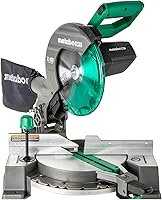
The Metabo HPT C10FCG2 is a light 24 lb single-bevel saw, which makes it easy to lift onto a bench or carry to a stand. Its large table gives work more support, so the bench top needs to be at least as large as the saw's base.
A saw's base height varies between models, so measure it before cutting legs. Our guide to what a miter saw is used for covers the cut types that decide whether you want a sliding or fixed-head model.
If you're weighing two brands at the same height, Bosch vs DeWalt miter saw compares how their bases and stands stack up.
How do you fix a table that feels too high or too low?
A low table gets a sturdy platform under the saw; a high table gets its legs trimmed. Both fixes keep the cutting surface near your elbow without rebuilding the whole bench.
For a low bench, cut a piece of thick plywood to the size of the saw base and set the saw on it. A 1-inch platform raises the surface by an inch, and you can stack a second piece if needed.
Bolt or clamp the platform so the saw doesn't slide.
For a high bench, trimming the legs is the cleanest fix, but it's easier to plan the height right the first time. If the bench is already built, a lower saw stand or a cut-down set of legs brings the surface down.
A too-high bench also pushes your shoulders up during long cuts, so fix it before you put in a long run of trim or decking.
What else should you check once the height is set?
Check reach, lighting and the head's swing before you commit to a final height. A bench that's the right height but leaves the blade in shadow still makes cuts harder to line up.
A saw with a built-in cutline light, like the WEN's LED guide, helps when the bench is deep and casts shadow. Position the bench so light falls on the cut line rather than behind the head.
A dust port and bag also need room behind the saw.
Try a few test cuts at your chosen height. If you find yourself stooping or lifting your shoulders, adjust the bench or platform by an inch.
Small changes make a big difference across a full day of cutting.
How high should a miter saw table be for most people?
For most people, set the cutting surface about 36 to 39 inches up, or at your elbow when you stand at the saw. Measure your own body rather than copying a number from a plan, then build or adjust the bench to match.
Set the legs so the bench top plus the saw base lands at that height. Add a platform under a low saw, or trim the legs on a high one.
Leave space behind the head for a sliding saw and room on both sides for long boards.
If you're still choosing the saw itself, what a miter saw is used for shows the cut types to match against your bench. And if you want a bench plan to follow, how to build a miter saw table takes the height decision and turns it into cut lengths.
Frequently asked questions
Does the table height change for a sliding miter saw?
The height stays about the same; what changes is depth. A sliding saw's rails and head swing back farther, so give it more room behind the bench and a stable base that resists tipping when the head is fully extended.
Can I use a workbench instead of a built table?
Yes, if the bench top lands near your elbow height and holds the saw firmly. Check that the top is flat and thick enough to mount the saw, and that the legs don't wobble when you press down on the handle.
Should the saw sit on a stand or on a table top?
A stand suits a saw you carry to job sites, while a fixed table suits a shop where the saw stays put. Match the stand's height to the same elbow check so the cutting surface stays at a comfortable level either way.
How do I raise a table that feels too low?
The easiest fix is a sturdy platform under the saw, such as a thick sheet of plywood cut to the base size. If you're building the table, plan the leg length so the top lands near your elbow before you mount the saw.