How to Cut a 45 Degree Angle with a Miter Saw
To cut a 45 degree angle with a miter saw, set the miter table to 45°, hold the workpiece firmly against the fence, and lower the blade through the material. Test the setup on scrap first and keep your hands outside the blade path.
On this page (8 sections)
- How do you set a miter saw to 45 degrees?
- What should you check before making the cut?
- How do you make a clean 45 degree cut?
- Should the blade bevel stay at zero?
- How can you cut two boards for a square corner?
- What causes a 45 degree cut to come out wrong?
- Which miter saw features help with 45 degree cuts?
- When should you use a different saw setting?
To cut a 45 degree angle with a miter saw, set the miter table to 45°, hold the workpiece against the fence, and lower the blade through the material. Test the setup on scrap first, then check the cut before trimming your finished piece.
A 45° angle across a board's face is a miter cut. Keep the blade bevel at 0° for a standard angled crosscut.
How do you set a miter saw to 45 degrees?
Turn the miter table until its pointer lines up with 45° on the scale. Keep the board flat on the table and pressed against the fence.
Unplug a corded saw before adjusting it, and follow the saw manual for any setup steps. Tighten the miter lock before cutting so the table stays in position.
Miter scales and stops can vary by saw. If the saw has a positive stop at 45°, engage it and still check the pointer.
For an overview of the cut types, see miter cut vs. bevel cut.
What should you check before making the cut?
Check the saw setting, workpiece position, and blade path before switching on. Mark the waste side of the line so you know which piece to keep.
Measure and mark the board with a square or protractor. Remember that the blade removes a thin strip of material, so place the blade on the waste side of your mark.
Set the board flat with its edge against the fence. Clamp it if your saw's instructions allow it and the clamp holds the work securely without entering the blade path.
Wear eye and hearing protection, keep your hands clear of the blade, and wait for the blade to stop before lifting it. Don't reach near the blade to clear scraps while it is moving.
How do you make a clean 45 degree cut?
Let the blade reach full speed, lower it steadily through the board, and release the trigger while keeping the saw head down. Wait for the blade to stop before lifting it and removing the offcut.
- Set the miter table to 45° and lock it.
- Place the board flat against the table and fence.
- Align the blade with the waste side of your mark.
- Secure the board as directed by the saw manual.
- Start the saw and let the blade reach full speed.
- Lower it smoothly through the board without forcing it.
- Hold the saw head down until the blade stops, then lift it.
Make a test cut on scrap of the same thickness first. Check the angle with a reliable square or angle tool, and adjust the setup if the cut misses 45°.
Should the blade bevel stay at zero?
Yes, leave the bevel at 0° for a regular 45° miter cut. The table turns the board across the blade, while a bevel setting tilts the blade through its thickness.
Tilting the blade as well creates a compound angle. That can be useful for crown molding or other shaped trim, but it changes the cut.
Read how to cut compound angles if your project needs both settings.
How can you cut two boards for a square corner?
Cut one board at 45° in one direction and the other at 45° in the opposite direction. Their angled ends should meet to make a 90° corner.
The miter table may need to turn left for one piece and right for the other. Keep the same face against the fence for both cuts, unless your project plan calls for a different orientation.
Test the pair on scrap first and check the assembled corner. For trim around a room, see how to cut baseboard corners.
What causes a 45 degree cut to come out wrong?
A wrong angle often comes from a loose table setting, a board that shifted, or measuring from the wrong edge. Check those points before changing the saw.
- The cut is short: account for the blade's cut width and keep the blade on the waste side of the mark.
- The angle is off: lock the table and verify the pointer against the scale.
- The board moved: improve support and clamp it if the manual allows.
- The cut splinters: use a suitable sharp blade, support the fibers, and make a steady pass.
A miter saw's scale helps set an angle, but the test piece shows whether the setup suits your saw and material. Learn more about choosing a blade in how many teeth a miter saw blade should have.
Which miter saw features help with 45 degree cuts?
A clear miter scale, a secure workpiece clamp, and a stable table can make setup easier. Match the saw's stated angle range to the cuts your project needs.
The DeWalt DWS715 has a 12-inch blade, 14 positive miter stops, and a tall sliding fence that supports 5-1/2-inch base vertically.
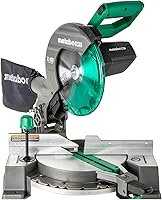
The Metabo HPT C10FCG2 has a 0–52° miter range to the left and right, plus a vice clamping system to secure the workpiece.
The Genesis GMS1015LC has a laser guide and 9 positive miter stops at commonly used angles. Check the laser against a test cut before relying on its alignment.
For other saw styles and sizes, browse compound miter saws: sizes, types, and picks.
When should you use a different saw setting?
Use the miter setting for an angled cut across the board's face, and use the bevel setting when the cut must tilt through its thickness. If the cut needs both, set both angles and test the result on scrap.
A 45° miter is a common way to join pieces at a corner, but the board's orientation and the direction of the angle matter. Mark the pieces before cutting so their faces and edges meet as planned.
For a basic 45° angle, set the table, lock it, secure the stock, and confirm the cut on scrap. Choose a saw with a 45° miter stop if you make this cut often, then use the scale and a test piece to verify each setup.
Frequently asked questions
Which setting makes a 45 degree cut on a miter saw?
Set the miter table to 45° for an angled crosscut. Keep the bevel setting at 0° if you want the cut angled across the board's face while its edge stays square.
Make a test cut on scrap and check the angle before cutting your finished piece.
Is a 45 degree cut a miter or bevel cut?
A 45° cut across the face of a board is a miter cut, made by turning the saw table. A bevel cut tilts the blade through the board's thickness.
If both settings are used together, the result is a compound cut.
How do I cut two pieces to make a 90 degree corner?
Cut each piece at 45° so the two angled ends meet to form a 90° corner. The pieces need opposite-facing angles, so set the miter direction for the second cut accordingly.
Test both pieces on scrap and check the assembled corner before trimming your final stock.
How do I keep a 45 degree cut from splintering?
Use a sharp blade suited to the material, support the workpiece, and let the blade reach full speed before cutting. Lower it steadily without forcing it through the wood.
A scrap backing piece can help support the fibers near the cut, but check that it sits flat and is safely clear of the blade.