How to Set Up a Miter Saw
To set up a miter saw, clamp it to a flat, sturdy bench at a height where the table sits near your hip, then square the blade to the fence and the base at 0 degrees. Check the bevel and miter detents, fit the dust bag, and make a test cut in scrap before your first real cut.
On this page (11 sections)
- Where should you put a miter saw in your shop or garage?
- What height should the saw table sit at?
- Can you run a miter saw on a normal household outlet?
- How do you mount a miter saw so it stays put?
- How do you check the blade and guard before setup?
- How do you square the blade to the fence?
- How do you check the bevel and miter detents?
- How do you fit the dust bag and plan the cut?
- How do you make a test cut and set up your stops?
- What should you check every time before you cut?
- Which setup checks matter most?
To set up a miter saw, clamp it to a flat, sturdy bench at a comfortable standing height, then square the blade to the fence and base at 0 degrees. Check the bevel and miter detents, fit the dust bag, and make a test cut in scrap before your first real cut.
The whole job takes about 20 minutes.
The steps below follow the order that matters: location and power first, mounting second, blade and angle checks third, then the test cut. A saw that isn't flat, square or firmly held will throw off every cut you make on it.
Where should you put a miter saw in your shop or garage?
Put the saw where you have room to feed long stock on both sides and where the blade won't throw dust at a walkway. A miter saw needs about 8 feet of clear space along the fence line for common boards.
Light the area so the blade and the cut line are easy to see without leaning over the table. Keep the floor clear of cords and offcuts so your feet stay planted while you hold the stock.
If you plan to cut long trim, position the saw near a wall opening or door so boards can pass through.
A spot with some airflow and an easy-to-sweep floor keeps the dust mess manageable. Skip carpet or a crowded corner where you can't move freely.
What height should the saw table sit at?
Set the bench so the saw's table is around hip height, roughly 36 to 39 inches for most standing users. That height lets you press stock down and against the fence with a relaxed arm.
A table that's too low makes you hunch over the blade, which tires your back and brings your face closer to the cut. Too high and you lose leverage to hold the board flat.
For thick lumber, go lower so you can press down firmly.
Test the height with a piece of scrap before mounting. Stand as you would to cut and check that your shoulders stay relaxed.
Adjust the bench rather than working at a height that feels wrong.
Can you run a miter saw on a normal household outlet?
A 15 Amp miter saw needs a circuit with little else running on it. These saws draw close to the limit of a standard 15 Amp household circuit, so lights or a shop vacuum on the same line can trip the breaker partway through a cut.
Plug the saw directly into a wall outlet rather than an extension cord where possible. If you must use a cord, pick a heavy-gauge one rated for the saw's current and keep it short.
A tripped breaker mid-cut can leave the blade stuck in the wood.
If your shop has a 20 Amp outlet, use it. Keep the cord routed behind the saw so it never crosses the cut line.
How do you mount a miter saw so it stays put?
Clamp or bolt the saw down so it can't slide or tip during a cut. Most miter saws have mounting holes in the base; bolting to a bench is the most secure option for a permanent spot.
For a portable setup, two clamps on opposite corners of the base hold the saw firmly enough for normal cuts. Check the bench itself for wobble before mounting, because a rickety table cancels out a solid clamp.
Don't rely on the saw's own weight to keep it still. A heavy saw can still walk when you pull a long board through a miter cut.
Confirm the blade guard moves freely after mounting. Setting up a compound miter saw follows the same rule: flat bench, firm hold.
How do you check the blade and guard before setup?
Unplug the saw, then inspect the blade, arbor bolt and guard before you make any adjustment. A dull or damaged blade won't cut square no matter how well the saw is set up.
Check that the blade teeth point down toward the table and that the arbor bolt is tight. Spin the blade by hand to confirm it turns freely and doesn't rub the guard or the table insert.
Look for missing teeth, cracks or heavy rust, and replace the blade if you find any.
Test the guard's movement through its full travel. It should cover the blade at rest and swing up smoothly as the head lowers.
Many saws ship with a general-purpose blade that handles trim and framing lumber but leaves rougher edges than a fine-tooth blade.
How do you square the blade to the fence?
Set the miter to 0 degrees and the bevel to 0 degrees, then lay a square against the fence and the flat of the blade. With the saw unplugged, check for gaps by eye or with a light behind the square.
If the square shows a gap at the blade's front or back edge, the miter pointer or the fence is off. Many saws let you loosen a pointer screw and reset it to read 0 when the blade truly sits square.
Fence adjustments follow the manual.
Repeat the check after tightening anything, because moving the fence can shift the reading. Once the blade is square to the fence, every miter angle you set later starts from a true reference.
The DeWalt DWS713 has a precise miter system and a machined base fence support, which makes this check easy to repeat.
How do you check the bevel and miter detents?
Swing the saw through its miter range and its bevel range and listen for the detents to click in. Then test each common angle against a square or a protractor.
The most-used stops are 0, 22.5, 31.6 and 45 degrees. On the Bosch CM10GD the miter detents sit at 0, 15, 22.5, 31.6, 45 and 60 degrees, and the bevel locks at 0, 33.9 and 45 degrees left and right.
If a detent feels soft or the pointer reads past the mark, follow the manual's adjustment.
The bevel lock should hold firmly without needing extra force. On dual-bevel saws like the Bosch, check both sides so you know the lock works when you tilt the head either way.
A bevel that drifts during a cut leaves a slanted face you won't notice until the pieces don't meet.
How do you fit the dust bag and plan the cut?
Fit the dust bag, or connect a shop vacuum, before your first cut. Most saws ship with a bag that clips or slides onto the discharge port.
Empty it before each session so airflow isn't blocked.
A dust bag catches the bulk of the chips; fine dust still escapes. Route the vacuum hose so it doesn't catch on the stock as you move it.
Whichever you use, keep the port clear of packed sawdust.
Check the blade's height and depth settings too. The blade should clear the tallest stock you plan to cut.
For more on what each cut does and when to use it, see what is a miter saw used for. If you're weighing a simple single-bevel machine against a compound one, our miter saw vs compound miter saw comparison covers the difference.
How do you make a test cut and set up your stops?
Cut a piece of scrap square at 0 degrees and check it against a square. If the cut reads true, set the miter stop and lock it down for repeated cuts.
Make the test cut with the stock held firmly against the fence and flat on the table. Let the blade reach full speed before lowering it.
After the cut, stand the piece on end and check the end grain against a square; light between the square and the cut tells you the blade isn't square.
If the test piece is off, go back to the blade and fence checks rather than adjusting by guesswork. Once 0 degrees is true, set your first real angle and cut another test piece.
For a saw that handles compound cuts, the compound miter saw guide explains how bevel and miter settings combine.
What should you check every time before you cut?
Confirm the saw is clamped, the blade guard works, and the miter and bevel locks are tight before every session. These three checks take seconds and cover the failures that matter most.
Also check that the blade is sharp and the arbor bolt is snug. Hold boards flat against the fence and keep your hand at least a blade's width from the cut line.
Unplug the saw when you change blades or reach into the table opening.
Setup drifts over time as bolts loosen and detents wear. Recheck square after moving the saw or dropping it.
If you're buying your first saw and want to keep costs low, our guide to the best budget miter saw covers what you get at that tier. The Bosch CM10GD's axial-glide system and 12 in horizontal cut capacity suit trim work and wide boards alike.
Which setup checks matter most?
If you only remember part of how to set up a miter saw, start with a flat bench and a square blade. Those two fix most accuracy problems before they begin.
Then confirm the power supply, the mounting, and the guard before the first cut.
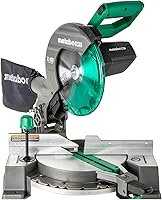
The Metabo HPT C10FCG2 is a sensible first saw for a small shop or a job site, given its 24 lb weight. The Bosch CM10GD suits readers who cut a lot of trim and want fast angle changes.
The DeWalt DWS713 covers common trim and framing cuts with its 14 positive stops. Set the saw up once, recheck square before each big project, and the machine will keep your miters tight.
Frequently asked questions
How do you set up a miter saw for the first time?
Clamp it to a flat bench, fit the blade and guard as the manual shows, then check that the blade sits square to the fence at 0 degrees. Adjust the miter pointer if it reads off, fit the dust bag, and test the saw in scrap wood before your first project.
What height should a miter saw be set at?
Set the bench so the saw's table sits around hip height for you, roughly 36 to 39 inches for most standing users. A table that's too low pushes you to bend over the blade, and one that's too high makes it hard to hold stock flat against the fence.
Do you need to bolt a miter saw to a bench?
Yes, clamp or bolt it down so it can't slide or tip during a cut. Most saws have mounting holes in the base for bolts; for a portable setup, two clamps on opposite corners of the base hold it firmly enough.
Never cut with a miter saw resting loose on a surface.
How do you check that a miter saw is square?
Set the miter to 0 degrees and the bevel to 0 degrees, then lay a square against the fence and the flat of the blade with the saw unplugged. If you see light between the square and the blade, loosen the miter pointer and reset it, or follow the manual's fence adjustment.
Why does a miter saw need a dedicated circuit?
A 15 Amp miter saw draws close to the limit of a standard 15 Amp household circuit, so lights or other tools on the same line can trip the breaker mid-cut. Plug it into a circuit with little else running, or a 20 Amp outlet where one is available.