How to Cut Long Boards With a Miter Saw
To cut a long board on a miter saw, support it level on both sides of the table, set the fence and stops, then cut with the blade path clear of clamps. The board stays flat and square, so the blade cuts where you marked it instead of wandering or binding.
On this page (10 sections)
- Why do long boards behave differently on a miter saw?
- What support do you need for a long board on a miter saw?
- How do you keep the board flat and square against the fence?
- Where does the offcut go, and where do you put the clamps?
- How do you mark and cut a long board for an accurate length?
- Does your saw have the capacity to cut long boards in one pass?
- Can a miter saw cut a long board on an angle?
- What changes when you cut dense or multi-material long boards?
- What mistakes cause bad cuts on long boards?
- What setup should you use for very long boards?
A long board is the one workpiece that makes a miter saw feel small. The saw is short and stable; the board is not.
The trick is to make the board behave like a short one: flat on the table, level on both sides, and supported so gravity cannot tip it into the blade.
Once that is done, learning how to use a miter saw to cut long boards comes down to a few setup habits and one pass through the kerf. This guide covers the stands, the flat base, the clamps, and the blade capacity you need for boards that overhang the table by several feet.
Why do long boards behave differently on a miter saw?
Long boards rock, tip, and lean because much of their weight sits past the table edge. A 12-foot 2x4 carries several feet of overhang on each side of the saw.
That overhang matters in three ways. First, any sag at the far end lifts the near end and changes the cut angle.
Second, the board can slide sideways along its length when the blade bites. Third, the fence only guides a short section of stock, so the rest of the board has nothing holding it.
On a worksite people often make the cut with one hand on the saw and the other hand fighting the board. That is where a small error turns into a big one.
Support removes the fight.
What support do you need for a long board on a miter saw?
Support both sides of the cut at the same height as the saw table. Even a 1/8-inch step between the table and a stand changes the geometry, because the blade cuts along the same line for the whole 2x thickness.
Set the stands so the board presses flat against the back fence along its length, not only at the saw. A stand under each overhang end, plus one close to the saw if the sag wants to develop, handles boards 12 feet and longer.
Keep the stands on a flat floor. A slope under one stand transfers to the board, and the far end will try to slide during the cut.
Should you buy a miter saw stand or use sawhorses?
Buy a miter saw stand if you need repeatable setups and one trip to move everything. A fold-out stand holds the saw at working height and gives you extension arms with height adjustment, which is exactly the job for long stock.
Sawhorses work for a one-off job if you shim them to the table height and check the level with a straightedge. A roller stand in the middle is cheap and adjustable, which matters when the board is heavy.
Avoid stacking boxes or resting the board on a chair. The board needs a stable, flat surface that does not shift when the blade touches it.
How do you keep the board flat and square against the fence?
Press the board flat to the table and tight to the back fence before the blade moves. A board that touches the fence at the cut and lifts at the overhang is the classic cause of a short cut, an uneven cut end, or kickback.
Hold the stock with your left hand pressed down and in, away from the blade line, then bring the head down with your right. Slide the board forward until the mark lines up with the kerf, not with the blade body.
Check the fence for square if your cuts drift. A long board amplifies any fence error, so a fence that is 1 degree off shows up as a visible gap at the far end of a long trim run.
Where does the offcut go, and where do you put the clamps?
Put the clamp on the offcut side if it clears the blade, and use the long side only if the clamp clears the blade path. The long side is what you need to hold down and keep against the fence; clamping it near the cut is fine only if the clamp does not cross the blade path.
The quick-clamp assembly on many saws mounts in the table slots, so mount it on the side where the short piece falls away. Then the heavy side stays free for your hand and the fence.
Sweep the blade path with the saw off before every cut. A clamp that sits 1/8 inch inside the path on a bevel cut will be hit, and the blade will bind.
How do you mark and cut a long board for an accurate length?
Measure from the same end you cut toward, mark the waste side, and cut on the far side of the line. Mark the line across the face, then bring the kerf to the waste edge, not to the keeper side.
For a long run of trim or shelving, use a stop block clamped to the fence on the offcut side. Set it once, then butt each board against it and cut.
The stop block on the short side does not interfere with the long stock coming in from the other end.
Write the measurement on painter's tape where you can read it, and double-check it before the blade drops. Long boards are expensive to replace after a short cut.
Does your saw have the capacity to cut long boards in one pass?
Crosscut capacity decides whether a long board needs one pass or two. A board wider than the saw's rated width will stall the blade or stop the cut short.
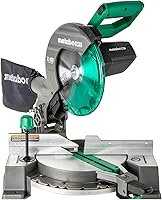
The {{product B0BK2VPL17 | A 15 Amp sliding saw that crosscuts boards up to 13.25 inches wide and 4.5 inches thick in one pass.}} The dual-rail slide lets the head travel through wide stock, so a long shelf or wide trim board does not need to be flipped and cut from both faces.
For a saw with a shallower body, the {{product B00G5R4E9A | Bosch's glide arms give a 12 inch horizontal cut while the saw body stays compact on the bench.}} The short front-to-back footprint leaves room for stands and clamps around the saw, which helps on a crowded bench.
If long boards are the main job, check the crosscut width on the saw you own before buying. A sliding saw gives the most width, and our guide to what a miter saw is used for explains which cuts each type handles best.
Can a miter saw cut a long board on an angle?
Yes, miter angles work the same on long stock once the work is supported flat. The board length does not change the miter setting; it only changes how much support the ends need.
Set the miter angle with the lock lever, lower the head to check clearance, and confirm the angle against the fence with a square or a miter saw protractor on the near end. Then make the cut with the same hold you would use on a short board.
Compound cuts on long trim need the bevel and miter both set before the cut. Slide the saw head back, check the blade clears the fence, and cut with a slow feed so the blade does not pull the board into the fence.
What changes when you cut dense or multi-material long boards?
Dense material needs a slower feed and a blade rated for it. A long steel or composite board transfers more vibration through the saw, so the cut finish depends on the blade and the steadiness of the board.
The {{product B07SK3PZRR | One blade that cuts wood, composite decking, mild steel and plastic, for long boards that mix materials.}} Its bevel runs 0 to 45 degrees and its miter range is 50 degrees each way, so you can cut long decking or framing at an angle without swapping blades between materials.
For ordinary framing lumber, keep the feed steady and let the motor hold speed. For metal, back the cut out slightly if the blade starts to chatter, and keep the offcut side clamped so a long piece does not drop and pinch the blade.
What mistakes cause bad cuts on long boards?
Sag, a lifted fence, and an unsupported offcut cause most bad cuts on long stock. Catch these three first and the rest usually falls into place.
A board that sags at the far end lifts off the near table, so the cut is not square. A board that leans off a stand drags along the fence and binds.
An offcut that drops away without support can pull the blade or tear the cut end.
Overloading a stand is another quiet problem. A long hardwood plank on a light roller stand can slide when the blade touches it, so check the load rating against the board weight before the cut.
Supporting long boards also changes the cut on a compound angle, and the miter saw vs compound miter saw guide explains when the extra bevel is worth setting up.
What setup should you use for very long boards?
A stand at each end plus one near the middle keeps very long stock flat. Boards 16 feet and longer need that middle support most, because the sag builds where nobody holds it.
Set up on level ground, measure the table height at the kerf, and match every stand to it with a straightedge across all three. Then test the board with the saw off: press it against the fence and let go.
If it springs back or lifts anywhere, adjust a stand before cutting.
Keep the wall behind the saw clear and give the far end room to run. Cut in the same pass pattern every time, and the boards will come out the same length.
For thicker stock, the can a miter saw cut a 4x4 guide covers capacity and pass limits. Once the stands and the flat base are right, the way to use a miter saw to cut long boards is to keep the board still, line the kerf to the mark, and cut with one hand keeping the board flat and against the fence while the other lowers the saw head.
Frequently asked questions
Can I cut a 16-foot board on a miter saw by myself?
Yes, if both ends rest on supports, but you cannot hold a 16-foot board flat with one hand and lower the head with the other. Set the far end on a stand and the near end on a sawhorse, then cut with one hand keeping the board flat and against the fence while the other lowers the saw head.
Why does my miter saw burn the end of a long board?
A dull blade, a slow feed, or a board that lifts slightly during the cut can all cause burning. Long boards are heavier, so they lean or shift more easily.
Support the overhang, hold it flat on the table, and let the blade reach full speed first.
Do I need to remove the clamps to cut a long board?
Only the clamp on the side where the board runs toward the cut. Put the clamp on the offcut side, or on the long side only if it clears the blade path.
Always check the blade path before the head comes down.
What is the widest board a sliding miter saw cuts in one pass?
It varies by model. The WEN MM1215 is rated for boards up to 13.25 inches wide and 4.5 inches thick in a straight crosscut, and the Bosch CM10GD has a 12-inch horizontal cut capacity.