How to Use a Miter Saw Protractor
To use a miter saw protractor, place its two arms into the corner so both rest flat on the walls, then read the angle on the dial. Halve that reading to set your saw's miter, or halve the difference from 90 degrees when the protractor's scale already reports the miter setting.
On this page (9 sections)
- What is a miter saw protractor and what does it read?
- How do you measure an inside corner with the protractor?
- How do you turn the reading into a miter saw setting?
- How do you set the miter on a compound miter saw?
- How do you measure and cut baseboard around a corner?
- How does the protractor help with crown molding?
- What mistakes throw off a protractor reading?
- How do you check the fit and fix a gap?
- What should you check before trusting the protractor?
To use a miter saw protractor, place its two arms into the corner so both rest flat on the walls, then read the angle on the dial. Halve that reading to set your saw's miter, or halve the difference from 90 degrees when the protractor's scale already reports the miter setting.
The tool takes the guesswork out of corners that are not square. A protractor measures the real corner, and your saw cuts the matching miter.
That is the whole idea, and the steps below walk you through how to use a miter saw protractor on inside corners, outside corners, baseboard and trim.
What is a miter saw protractor and what does it read?
A miter saw protractor is a two-armed angle finder with a dial that reads the corner between two surfaces. One arm holds against each wall, and the pointer shows the angle on the scale.
Most models cover 0 to 180 degrees. Many print a second scale that gives the miter setting directly, so the number on the dial can be used on the saw without extra math.
The arms are short enough to fit into a corner behind baseboard or against a door casing. Some lock with a thumb screw so the reading stays put while you walk to the saw, and others hold by friction alone.
A protractor gets you close on the wall, and the test cut closes the gap. Treat it as the first step, not the final word.
How do you measure an inside corner with the protractor?
Measure an inside corner by opening the protractor arms and pressing each one flat against a wall in the corner. Keep the dial flat and level, and read the pointer where it settles.
Set the arms wide enough to span the corner without forcing them. Both arms should touch the wall along their length, not just at the tips, because a rocking arm gives a wrong reading.
Read the scale marked for inside corners on your model. If yours has only one scale, note the raw angle and plan to split it.
A true square corner reads 90 degrees, and most rooms are a few degrees off. Write the reading down before you move.
Walls with texture or a rounded corner bead make the arms sit unevenly, so measure a second time a little higher or lower and compare the two numbers.
How to measure an outside corner
Measure an outside corner by hooking the protractor over the corner and holding both arms against the two faces. The pointer reads the angle across the outside of the corner.
An outside corner on square trim reads 90 degrees on the protractor's outside scale. A corner that reads 135 degrees needs miters of 67.5 degrees on each piece, which is beyond many saws.
Check your saw's miter range before you commit to the cut. Hold the protractor steady with one hand and read with the other, and measure at the height where the new trim will sit.
How do you turn the reading into a miter saw setting?
Turn the protractor reading into a saw setting by splitting the corner angle in half, then setting the miter to that number. The two pieces that meet share the angle equally.
For a 90 degree corner, each piece gets a 45 degree miter. For a 94 degree corner, each piece gets 47 degrees.
If your protractor prints a miter scale, read that number directly, because it already did the halving for you. Check which scale you used before you touch the saw.
Some protractors report the angle from the fence instead of the corner. That number is the miter setting, so it goes straight onto the saw's scale.
Then set the saw. Lock the miter detent, loosen the table, and move the head until the pointer lines up with your number.
Tighten the lock and recheck the pointer before cutting.
How do you set the miter on a compound miter saw?
Set the miter on a compound miter saw by loosening the table lock, turning the table to your angle, and locking it again before you lower the blade. The miter scale sits at the front of the table on most saws.
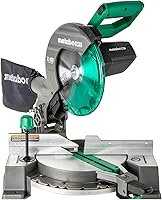
The Metabo HPT C10FCG2 has a miter range of 0 to 52 degrees left and right and an improved miter scale with controls for accurate adjustments. That range covers the common corner splits you'll meet on baseboard and casing.
The DeWalt DWS713 uses a stainless-steel miter detent plate with 14 positive stops. Positive stops lock the table at common angles like 45 degrees so the setting does not creep between cuts.
The Makita LS1040 gives you 9 positive miter stops at 15, 22.5, 30 and 45 degrees left or right, plus 0 degrees. Its dual post compound pivoting arm holds the head steady as you swing it.
Set the miter first, then the bevel if your cut needs one. On a single-bevel saw the head tilts one way only, so plan the cut before you lock anything down.
How do you measure and cut baseboard around a corner?
Cut baseboard around a corner by measuring the wall angle with the protractor, splitting it, and cutting both pieces to the matching miter. Inside corners get an inside miter, and outside corners get an outside miter.
Hold the protractor at the baseboard height, not up at eye level. The wall can lean slightly, and the reading at the floor is the one that matters.
Mark the reading on the back of the trim piece. Cut one piece, then test fit it against the wall before cutting its partner, because a test fit catches a misread corner while you still have material to spare.
Adjust the saw a degree at a time if the joint opens. Use a fine-tooth blade for trim so the cut edge stays clean, since a coarse blade tears the paint line and makes the joint harder to hide.
Let the blade stop before you lift the head.
How does the protractor help with crown molding?
The protractor gives you the wall corner angle, and you still need the molding's spring angle to set the saw. The spring angle is how far the molding leans back from the wall, and it varies by profile.
Measure the corner first. Then find the miter and bevel pair for that wall angle and the spring angle of your molding.
Many protractors print a crown chart on the back for common spring angles like 38 and 45 degrees. Crown is often cut nested against the fence, which means the molding sits in its installed position on the saw.
In that case the miter setting comes from the wall angle and the bevel stays at zero. The protractor's corner reading is what feeds the chart.
Test the first cut on scrap molding before you cut the good stock, because a wrong bevel wastes a long piece. A small test offcut saves the run.
What mistakes throw off a protractor reading?
The most common mistake is letting one arm lift off the wall, which skews the angle. Hold both arms flat and keep the dial level before you read.
Other frequent errors:
- Reading the wrong scale on a dual-scale dial.
- Forgetting to split the corner angle before setting the saw.
- Setting the miter but leaving the bevel unprotected.
- Cutting before checking the blade is square to the fence.
- Trusting a reading taken at the wrong height on the wall.
Check the saw's square before a trim run. A blade that leans a degree throws every miter off, and no protractor reading can fix that.
Our guide to what a miter saw is used for covers the basic cuts and setup. If you're choosing a saw for trim work, compare a budget miter saw against the compound models before you buy.
And if you're unsure which saw type fits your corner cuts, our miter saw vs compound miter saw breakdown explains the difference.
How do you check the fit and fix a gap?
Check the fit by dry fitting both pieces in the corner before you fasten anything. A tight joint shows no light through the seam when you press the pieces together.
If a gap appears, the corner reading or the saw setting is slightly off. Recheck the protractor against the wall and compare it with your saw's pointer.
Adjust the miter by a degree and recut a test piece. Small gaps in painted trim can be filled with caulk after the joint is fastened, but large gaps need a recut, because filler will crack as the wood moves.
Don't force a miter closed with clamps. For a longer trim run, measure each corner separately, because rooms are rarely consistent and a protractor reading at one end of a wall does not fit the other.
Carry the protractor along the run.
What should you check before trusting the protractor?
Trust the protractor after you confirm it reads a known square corner as 90 degrees. A dropped tool can bend the pointer or shift the dial, and every reading after that is off.
Test it against a carpenter's square or a door frame you know is square. If the reading is off by more than a degree, check the pointer screw or replace the tool.
Store the protractor flat and away from moisture. The arms can warp if they sit in a hot truck or a damp toolbox, so wipe the dial clean so the numbers stay readable.
For the wider picture on how a sliding saw handles long trim runs, see how to use a sliding compound miter saw. That saw type can crosscut wide baseboard in one pass.
To answer the main question, how to use a miter saw protractor comes down to three moves: measure the corner with both arms flat, split the angle in half, and set the saw to that number. Test fit, adjust by a degree if needed, and the joint closes cleanly.
Pick a protractor with a miter scale if you cut trim often, because it removes the math on every corner. Keep the saw's blade square to the fence and the miter lock tight, and the protractor reading will match the cut you get.
Frequently asked questions
What angle does a miter saw protractor measure?
It measures the corner angle between two surfaces, usually 0 to 180 degrees. The same dial often prints the matching miter setting so you can read the angle to set on the saw without doing the math.
Do I set the saw to the corner angle or to half of it?
Set the saw to half the corner angle when the corner is split evenly between two matching cuts. A 90 degree corner needs 45 degree miters, and a 100 degree corner needs 50 degree miters on both pieces.
How do I check whether the protractor reads inside or outside corners?
Hold the arms flat against both walls and look at the scale the pointer sits over. Many protractors print two scales, so read the one labeled for the corner type you're measuring rather than the first number you see.
Can I use a protractor for crown molding?
Yes, but you also need the spring angle to turn the wall reading into a miter and bevel. Measure the corner first, then set the saw using the miter and bevel pair for that wall angle and your molding's spring angle.
Why does my joint open up when I use a protractor?
A tiny error in the reading, blade thickness or fence alignment shows up as a gap. Measure the corner, split the angle, cut a test piece and adjust the saw a degree at a time before cutting your good trim.