How to Cut a 10 Degree Angle With a Miter Saw
To cut a 10 degree angle with a miter saw, swing the table to the 10 degree mark, lock it, and make a slow, steady cut with the stock clamped. The scale reads degrees off square, so 10 on the miter scale means the blade crosses the fence at 10 degrees, not 80.
On this page (9 sections)
- How do you set a miter saw to 10 degrees?
- What does a 10 degree miter actually mean on the scale?
- How do you clamp and cut so the angle stays clean?
- Do you ever need two 10 degree cuts?
- How do you cut a 10 degree angle on a compound saw?
- Which blade gives clean 10 degree cuts?
- How do you check a 10 degree cut came out right?
- Which miter saw suits small-angle work?
- How do you cut a 10 degree angle with a miter saw safely?
To cut a 10 degree angle with a miter saw, swing the table to the 10 degree mark, lock it, clamp the stock, and cut slowly. The scale reads degrees off square, so 10 on the miter scale means the blade crosses the fence at 10 degrees, not 80.
That second point trips up most beginners. Once the reading is clear, the rest is a short setup: square the fence, set the table, lock it, and cut a test piece before you touch the good board.
How do you set a miter saw to 10 degrees?
Set the table to the 10 degree mark and lock it down. Most saws show 10 degrees on the left side of the scale, so the blade swings left and the cut slopes across the end of the board.
Loosen the miter lock handle and swing the table until the pointer lines up with 10. Then tighten the lock so the table can't creep during the cut.
If your saw has a detent near 10, press the detent override so the table settles at your exact spot rather than snapping to a preset.
The DeWalt DWS713 has a stainless-steel miter detent plate with 14 positive stops, plus a turn knob lock for repeatable settings. A saw like that makes 10 degrees easy to dial because the plate is stable and the pointer stays where you set it.
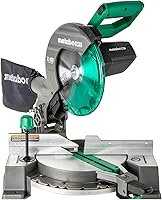
On the Metabo HPT C10FCG2, the miter scale runs 0-52 degrees left and right with an improved scale and controls. That range covers 10 degrees many times over, and the wider scale gives you finer marks around the small angle.
What does a 10 degree miter actually mean on the scale?
A 10 degree miter is 10 degrees off a square cut, not 10 degrees off the fence. If the scale reads 0, the blade sits square to the fence and the cut is 90 degrees to the board edge.
A common mistake is reading the scale upside down. At 45 degrees on the scale, the blade sits halfway between square and parallel, and the two mating cuts add to 90.
At 10 degrees, the blade is only slightly angled, and two 10 degree cuts add to 20.
So when a plan calls for 10 degrees, set the table to 10 and trust the number. Don't subtract it from 90, because the saw's scale is already built that way.
If a project calls for a familiar angle, our guide to cutting a 45 degree angle with a miter saw shows the same scale in a different setting.
How do you clamp and cut so the angle stays clean?
Clamp the stock against the fence, start the saw away from the wood, and feed slowly through the cut. A small angle like 10 degrees means the blade meets the end grain at a shallow slope, and that can pull the offcut if you rush.
Hold the board flat on the table and tight to the fence. The DeWalt vertical clamp included with the DWS713 holds the workpiece down so your hands stay clear.
The Metabo HPT vice clamping system does the same job, securing the board for precision and safety.
Let the blade reach full speed before you touch the wood. Cut at a steady pace, and let the blade stop before lifting the head.
A fast cut on a shallow angle can chip the back edge, and a stalled blade can burn the end grain.
When should you cut from the other side?
Cut from the other side when the blade would otherwise blow out the face you want to keep. On a 10 degree trim cut, the blade exits the far corner of the board, and that corner often shows on finished work.
Mark the waste side and orient the board so the tear-out lands where it won't show. With a tight fence and a slow feed, most 10 degree cuts come out clean on both sides.
Do you ever need two 10 degree cuts?
Yes, when you're wrapping a corner or matching a pair of pieces. Two 10 degree cuts that meet make a 20 degree joint, and two that face each other on a frame close an angle.
Check your plan before cutting the second piece. Cutting one end at 10 and the other at 0 gives a tapered part, which is what you want for a slight wedge or a shim.
Cutting both ends at 10 gives a symmetrical part for a frame.
Mark each end clearly if the two cuts differ. A quick pencil line on the waste side prevents flipping the board the wrong way, which is the most common waste on a short trim piece.
How do you cut a 10 degree angle on a compound saw?
Set the miter to 10 degrees and leave the bevel at 0. That's the plain miter cut, and it's all most 10 degree jobs need.
A compound saw gets its name from combining a miter with a bevel. Tilting the head as well as the table changes the angle on the face of the board, which matters for crown molding and other two-plane cuts.
Those setups are covered in our guide to cutting compound angles on a miter saw, and they're a different job from a simple 10 degree trim cut.
If you're new to the tool and want the broad picture first, what a miter saw is used for covers the main cut types in plain terms.
Which blade gives clean 10 degree cuts?
Use a fine crosscut blade for trim and a general-purpose blade for framing. A 10 degree cut is still a crosscut, so tooth count and a sharp edge matter more than the angle itself.
The Freud LU91M010 is a 10 inch thin kerf sliding compound saw blade with 60 teeth and a 5/8 inch arbor. Its negative hook angle pushes the work down toward the fence for smooth feeding, and the 60 teeth leave a fine finish on trim stock.
A thin kerf removes less material, which suits saws that benefit from a lighter load. If you're cutting aluminum with a miter saw instead of wood, the blade and speed rules change, and whether a miter saw can cut aluminum explains the limits.
How do you check a 10 degree cut came out right?
Test the fit on scrap before you cut the good stock, then measure the angle against your reference. A quick trial saves a board.
Cut a piece of scrap at 10 degrees and lay it against the corner or the mating piece. Look for a gap or a proud edge, and nudge the table slightly if the fit is off.
Many saws let you fine-tune the pointer, and a small adjustment now prevents a visible gap later.
A digital angle finder confirms the blade angle on the table rather than relying on the sticker. For a 10 degree setting, the finder should read close to 10 degrees between the blade and the fence.
Which miter saw suits small-angle work?
A 10 inch compound saw with a stable detent plate and a clear scale handles 10 degree cuts all day. Pick a saw with a miter range that covers both sides, a fence tall enough for your trim, and a clamp that holds small pieces safely.
The Metabo HPT C10FCG2 is a 10 inch single bevel compound saw with a 15 amp motor and a 0-52 degree miter range left and right. It weighs 24 lbs, so it moves easily between rooms or to a job site.
The DeWalt DWS713 is also a 10 inch single bevel saw with a 15 amp motor, and its tall sliding fence supports 4-1/4 inch base vertically. That fence height helps when you cut base or crown at a slight angle.
Both saws run on corded power, so plan an outlet or an extension cord. For small trim, a 10 inch blade gives you enough depth without overhanging the cut.
How do you cut a 10 degree angle with a miter saw safely?
Treat the cut like any other miter cut and keep your hands out of the blade path. Clamp the stock when the piece is short, and never hold a small offcut by hand next to the blade.
Wear eye protection and keep the guard working. Let the blade stop completely before you reach for the piece, and unplug the saw before changing the blade or adjusting the fence.
A 10 degree cut feels minor, but the shallow angle can still throw a sliver. A clean setup and a steady feed are the whole job.
Cut a scrap first, check the fit, then cut your good board at 10 degrees with confidence.
Frequently asked questions
What is the difference between a 10 degree miter and a 10 degree bevel?
A miter tilts the blade left or right along the table, so the cut shows on the end of the board. A bevel tilts the motor head side to side, so the cut slopes across the face.
Most 10 degree trim work is a miter.
How do I double-check a 10 degree cut before trimming the whole board?
Cut a scrap first and test the fit against the corner or the mating piece. Lay the two pieces together and look for a gap, then adjust the table a touch before you cut the real stock.
Why does my saw stop near 10 degrees but not land on it?
The detent plate holds its positive stops at common angles, so a 10 degree setting sits between them. Swing the table just past the stop, then tighten the miter lock while the pointer sits on the 10 degree mark.