What Does Single Bevel Mean on a Miter Saw?
Single bevel means the saw's blade tilts to one side only, usually to the left. You set the miter angle by rotating the table and the bevel angle by leaning the head, but every bevel cut leans the same way, so you flip the workpiece for the opposite side.
On this page (9 sections)
- What does single bevel mean on a miter saw?
- How is a single bevel saw different from a dual bevel saw?
- What cuts can a single bevel saw handle?
- Which side does a single bevel saw tilt, and why does it matter?
- How do you cut both sides of a beveled joint on a single bevel saw?
- Do you lose cutting capacity with a single bevel saw?
- When is a single bevel saw the right choice?
- Which single bevel saws fit which jobs?
- Final word on single bevel miter saws
A single bevel miter saw tilts its blade to one side only, almost always the left. The table still swings both ways for miter cuts, so the limit is only in the bevel direction.
For a bevel on the other face you turn the workpiece over.
What does single bevel mean on a miter saw?
Single bevel means the saw head tilts in one direction only, while the miter table turns in both directions. The bevel is the lean of the blade off vertical; the miter is the swing of the table under it.
A single bevel saw gives you full miter range but a bevel that goes one way.
Manufacturers usually build that tilt to the left. The DeWalt DWS713, for example, bevels from 0 to 48 degrees to the left and only 0 to 3 degrees to the right.
That small right tilt is clearance, not a working bevel range.
So when a cut needs the blade leaning right, you flip the board so its far edge faces the other way. The cut is identical; only the handling changes.
That is why single bevel saws stay popular: the joint quality is the same, and the price is lower.
How is a single bevel saw different from a dual bevel saw?
A dual bevel saw tilts left and right without flipping the board. Everything else, the miter table, the motor, the blade, works the same way.
If you want the full comparison, see what is a dual bevel miter saw.
The handling gap shows up on beveled joints where two pieces meet at an angle. With a single bevel saw you cut one piece with the head tilted and the other with the board flipped over.
On a dual bevel saw both cuts happen with the head tilted.
For a one-off picture frame, the flip costs seconds. For 40 feet of baseboard, you'll feel every flip, and each one is a chance to load the board the wrong way.
Dual bevel saws cost more and weigh a little more, because the head has to pivot both ways. Neither type changes the accuracy of a cut you set up correctly.
What cuts can a single bevel saw handle?
A single bevel saw cuts miters, bevels and compound angles, including the joints most trim work needs. The only thing it can't do is tilt right without you turning the board.
Miter cuts run at an angle across the board, and the table swings both ways, so left and right miters are equal. Bevel cuts lean the head into the edge of the material; a left tilt covers picture frames, cabinet face frames and most chamfers.
Compound cuts combine both at once, such as a 45-degree miter with a 45-degree bevel for crown molding. The WEN MM1014T handles compound cuts in boards up to 9.5 inches wide and 1.8 inches thick at that setting.
The one habit to learn: when a cut needs the blade on the other side of the board, flip it end for end and keep the same face against the fence. Mark your waste side clearly so a flip doesn't turn a good piece into scrap.
If the basics are still new, what is a miter saw used for covers the full range of cuts.
Which side does a single bevel saw tilt, and why does it matter?
The head tilts left on nearly every single bevel saw, so bevel cuts are easiest when the waste is on the left of the blade. The tilt direction decides how you present the board to keep the good face up and the offcut in the right place.
Picture a baseboard lying flat on the table. A left bevel with the board against the fence trims the top edge toward you.
To bevel the matching piece on the other end, you rotate the board so the same edge faces the blade.
On a saw with a tall sliding fence, like the DeWalt's, you also need clearance behind the head as it leans. Plan the flip before you raise the blade; a board that can't clear the fence will bind.
The small right tilt helps when the head needs to clear the fence for a near-square cut. It is not a substitute for a real right bevel, so don't count on it for mirrored joints.
How do you cut both sides of a beveled joint on a single bevel saw?
Cut the first piece with the head tilted, then flip the second piece end for end and cut it with the same tilt. The two bevels end up mirrored because the boards face opposite ways, not because the blade moved.
- Set the miter angle on the table as usual.
- Set the bevel angle on the head; it tilts left.
- Cut the first piece with the good face toward the fence or up, whichever your layout requires.
- Flip the mating piece end for end so its opposite face meets the blade.
- Cut at the same bevel and check the fit before trimming further.
Do a test cut on scrap from the same stock. Trim moves with humidity, so a joint that fits at the saw can open a hair by the time it's nailed.
A test piece tells you whether to adjust the bevel by a degree or leave it.
Support long pieces at both ends. A board that sags rocks on the table and the bevel comes out off-square.
That's a setup problem, not a saw-type problem. How to adjust a miter saw covers squaring the fence so the flips land on the same angle.
Do you lose cutting capacity with a single bevel saw?
No, single bevel and dual bevel saws of the same blade size cut the same size boards. Capacity comes from the blade diameter, the fence height and, on sliding models, the rail length.
The bevel direction doesn't change how wide or tall a board you can crosscut.
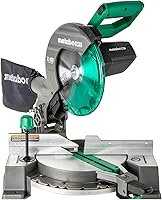
The Metabo HPT C10FCG2 is a 10-inch single bevel saw with a 15-Amp motor and a large table for material support. The DeWalt DWS713 crosscuts 2-inch by 6-inch lumber at 90 degrees and 2-inch by 4-inch at 45 degrees.
Its tall sliding fence holds 4-1/4 inches of base vertically.
A sliding single bevel saw adds reach. The WEN MM1014T crosscuts boards up to 13.4 inches wide and 3.5 inches thick at a square setting.
That extra width comes from the rails, not from having two bevel directions.
So if you need to cut wide trim or thick posts, look at the capacity numbers and whether the saw slides. A dual bevel saw with the same blade and fence cuts the same boards; you just tilt the head instead of the board.
When is a single bevel saw the right choice?
A single bevel saw is the right choice when bevels are occasional and you want to spend less on the saw. Framing, decking, shelving and straight trim rarely need a mirrored bevel, and the board flip takes seconds.
It also suits small shops and job sites where weight matters. The Metabo HPT C10FCG2 weighs about 24 lbs, which is easy to carry up stairs and set up alone.
The DeWalt DWS713 is around 31 lbs with a built-in carry handle.
Choose a dual bevel saw instead when beveled joints are a daily task. Long crown molding runs and repeated baseboard work reward a saw that tilts both ways, because you stop flipping boards and start cutting faster.
If you're still weighing the tool types against each other, miter saw vs compound miter saw explains where the compound head fits. For the bevel question alone, the rule is simple: count how often you cut bevels on both faces of a joint, and buy the saw that matches that count.
Which single bevel saws fit which jobs?
Pick by capacity and portability first, then by bevel range. These three saws cover most buyer needs, from a fixed shop bench to a sliding saw for wide trim.
Best for accurate repeat cuts
The DeWalt DWS713 has a stainless-steel miter detent plate with 14 positive stops and a machined base fence support. Its 15-Amp motor spins at 5,000 rpm.
A 10-inch blade and tall sliding fence make it a solid bench saw for trim and framing.
Best for carrying between jobs
The Metabo HPT C10FCG2 weighs about 24 lbs and miters 0 to 52 degrees left and right. Its bevel range runs 0 to 45 degrees to the left.
A large table gives boards more support, and the vice clamp holds the workpiece.
Best for wide boards and thick stock
The WEN MM1014T slides on rails to crosscut boards up to 13.4 inches wide and 3.5 inches thick at a square setting. It has 5 positive miter stops and a laser for the cutline.
Bevel and miter both reach 45 degrees.
Final word on single bevel miter saws
A single bevel miter saw tilts left and asks you to flip the board for the other face, and that's the whole trade-off. It cuts the same joints as a dual bevel saw at a lower price and often lower weight.
Pick a single bevel saw if bevels are occasional and your main work is miters, framing or flat trim. Choose the DeWalt for repeat trim cuts, the Metabo HPT for portability and a wide miter range, or the WEN when you need sliding reach for wide boards.
Go dual bevel only when beveled joints on both faces are a regular part of your work.
Frequently asked questions
Is a single bevel miter saw the same as a compound miter saw?
Often yes, because most saws sold as compound miter saws are single bevel. The compound part means the head both miters and bevels; the single bevel part says the tilt goes to one side only.
Can you cut crown molding on a single bevel saw?
Yes, if you nest the molding against the fence and table at its real wall angle. It takes more flipping and test cuts than a dual bevel saw, so check the saw's stated vertical capacity first.
Why do some single bevel saws tilt slightly to the right?
A small right-side tilt, often a few degrees, lets the head clear the fence and reach certain cuts. It is a clearance feature, not a full bevel range, so plan your opposite-side bevels around the left tilt.
Does a single bevel saw limit the miter angles I can cut?
No. The miter table turns left and right across its full range, so miter cuts are unaffected.
Only the bevel direction is limited, which matters when both mating pieces need a beveled edge.
When is a dual bevel saw worth the extra cost?
It earns its keep when you cut lots of beveled joints on both faces, such as repeated crown or baseboard runs. If bevels are rare in your work, a single bevel saw covers the same joints with a flip of the board.