Do You Need a Miter Saw for DIY Projects?
You need a miter saw if you regularly make accurate crosscuts or angled cuts in boards and trim. For occasional straight cuts, a hand saw or circular saw may be enough.
On this page (10 sections)
- Do I need a miter saw for the cuts I make?
- When is another saw enough?
- What DIY projects benefit most from a miter saw?
- Will a miter saw fit your workspace?
- Which miter saw features matter for DIY?
- Which miter saws fit different DIY needs?
- How should you set up and care for a miter saw?
- What common miter saw buying mistakes should you avoid?
- How can you decide if you need a miter saw?
- FAQs about needing a miter saw
You need a miter saw if your DIY projects call for repeated, accurate crosscuts or angled cuts. If you make only occasional straight cuts, a hand saw or circular saw may cover your needs with less setup and storage.
Start with the jobs you expect to do. Trim, flooring, frames, shelves, and small furniture can involve many pieces cut to matching lengths or angles, while a one-off repair may need only a few basic cuts.
Do I need a miter saw for the cuts I make?
A miter saw is useful when you need repeatable crosscuts, miter cuts, or bevel cuts. It holds the work against a fence while a mounted blade moves through the material, helping you set up a series of matching cuts.
A miter cut angles across a board's face; a bevel cut angles through its thickness. See what a miter saw is used for for project examples, and compare miter cuts and bevel cuts if you're unsure which your project needs.
The time savings are clearest when several pieces need the same length or angle. For a few cuts now and then, measuring and using another saw may be simpler.
When is another saw enough?
A hand saw or circular saw may be enough for occasional straight cuts. A circular saw can follow a guide for straighter cuts and travel along larger workpieces, while a miter saw stays in one place as you bring the material to it.
A miter saw is less suited to long cuts along a board or cuts through large sheets. If your projects involve those jobs more often than trim and crosscuts, a circular saw may be the more useful first tool.
The right choice depends on the cut, material, and workspace. Read miter saw vs. circular saw for a closer comparison.
Is a miter saw worth it for one project?
It can be worth using one for a project with many matching cuts or precise trim angles. If you need it for just one project, consider borrowing or renting one before making room for a permanent tool.
What DIY projects benefit most from a miter saw?
Projects with repeated board and trim cuts tend to benefit most. Baseboards, door casing, picture frames, shelves, and furniture parts often call for several pieces at matching lengths or angles.
Trim corners commonly need miter cuts, while some joinery combines a miter and bevel. If you're fitting baseboards, follow our guide to cutting baseboard corners with a miter saw.
A miter saw is for crosscutting boards and trim within its capacity, not ripping long boards or cutting large sheets. Check the width and thickness of your material before planning around a saw.
Will a miter saw fit your workspace?
Check the saw's footprint, the support needed for long pieces, and where you'll store it. It needs a stable surface, room for the workpiece, and clearance for the saw head and blade to move.
Long boards may need support on both sides of the saw. Keep the workpiece flat against the fence and table, and follow the manual for clamping and cutting.
A compact design may suit a small shop or a space where storage matters. A sliding saw can handle wider material than a comparable non-sliding design.
Its rails also need clearance. Learn what a sliding compound miter saw is before choosing one.
Which miter saw features matter for DIY?
Match the saw's cut capacity and functions to the materials and angles you expect to use. A basic miter saw handles crosscuts and miters; a compound model also tilts for bevel cuts.
A sliding design adds travel that can increase crosscut capacity. A dual-bevel saw tilts both left and right, which can reduce the need to reposition a workpiece for some angled cuts.
Our guide to what to look for in a miter saw explains which features may fit your work.
Don't choose by blade size alone. Compare the stated capacity with your material, and account for space and any stand or dust collection you may need.
Which miter saws fit different DIY needs?
Choose by power source, capacity, and workspace. These three options show different fits: a corded 10-inch compound saw, a cordless 7-1/4-inch saw, and a corded sliding saw with compact rails.
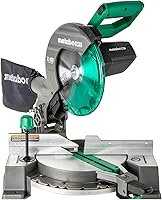
The Metabo HPT C10FCG2 is a corded, single-bevel compound saw with a 10-inch blade. Its miter range goes from 0–52° left and right, with bevel adjustment up to 45° left, making it a practical fit for a fixed home work area and projects that need bevels.
The DeWalt DCS361B is a cordless 7-1/4-inch saw with an integrated cut line positioning system and 11 positive miter stops. At 30 lb, it may suit DIYers who need to move a saw between work areas; skip it if you need a corded setup or more capacity for wide material.
The Skil MS6306-00 is a corded, single-bevel sliding saw with a 7-1/4-inch blade and a fixed compact rail system designed to work flush against a wall. Its stated capacity is up to a 2x10 crosscut at 0°, so it suits DIYers who need sliding capacity in a tighter workspace; skip it if you don't need that capacity or bevel cuts to the right.
How should you set up and care for a miter saw?
Set the saw on a stable surface, leave room for the blade and workpiece, and support long boards. Before cutting, check that the material sits flat against the table and fence and secure it with a clamp when appropriate.
Read the manual for the specific saw before its first use. Wear eye and hearing protection, keep hands clear of the blade path, wait for the blade to stop before lifting it, and never remove the guard or reach near a moving blade.
Keep the table and fence clear of scraps before setting up each cut. Unplug a corded saw or remove its battery before changing a blade or doing maintenance, and follow the manual's cleaning and care instructions.
What common miter saw buying mistakes should you avoid?
The most common mistake is buying for a blade size or feature before checking the actual cut capacity you need. Measure your widest and thickest material, then compare it with the saw's stated capacity at the angles you plan to use.
Don't overlook the space behind and beside a sliding saw, or the support long boards need. A compact footprint can help in a small shop, but the full work area still needs to fit the job.
Also consider power and portability together. A corded saw fits a work area with a suitable outlet; a cordless model is easier to move, but check battery compatibility and availability before choosing one.
How can you decide if you need a miter saw?
Get a miter saw if you regularly make repeat crosscuts or angled cuts and have room to use and store it. If you mostly make occasional straight cuts, a hand saw or circular saw may be a better fit.
Choose a compound saw when your work needs bevels, and a sliding model when its added crosscut capacity solves a real material-size problem. For a broader overview, start with compound miter saw sizes and types.
FAQs about needing a miter saw
Do I need a miter saw for home projects?
A miter saw is useful if you often make repeated crosscuts, miter cuts, or bevel cuts in boards and trim. For occasional straight cuts, a hand saw or circular saw may cover your needs.
Consider the materials, angles, and workspace your projects require before choosing.
Can a circular saw replace a miter saw?
A circular saw can handle many straight cuts and some angled cuts with a guide, so it may cover occasional DIY needs. A miter saw is easier to set up for repeated crosscuts at matching lengths and angles.
Choose based on the cuts you make most and the space you have.
Is a miter saw useful for beginners?
A miter saw can help beginners make repeatable crosscuts and trim angles, but it takes safe setup and careful handling. Read the manual, secure the workpiece, keep hands clear of the blade path, and wear eye and hearing protection.
What size miter saw should I get for DIY?
Choose a saw based on the width and thickness of the material you plan to cut, plus how much room you have to store and use it. A larger blade does not automatically fit every project.
Check the saw's cut capacity against your materials before buying.
Frequently asked questions
Do I need a miter saw for home projects?
A miter saw is useful if you often make repeated crosscuts, miter cuts, or bevel cuts in boards and trim. For occasional straight cuts, a hand saw or circular saw may cover your needs.
Consider the materials, angles, and workspace your projects require before choosing.
Can a circular saw replace a miter saw?
A circular saw can handle many straight cuts and some angled cuts with a guide, so it may cover occasional DIY needs. A miter saw is easier to set up for repeated crosscuts at matching lengths and angles.
Choose based on the cuts you make most and the space you have.
Is a miter saw useful for beginners?
A miter saw can help beginners make repeatable crosscuts and trim angles, but it takes safe setup and careful handling. Read the manual, secure the workpiece, keep hands clear of the blade path, and wear eye and hearing protection.
What size miter saw should I get for DIY?
Choose a saw based on the width and thickness of the material you plan to cut, plus how much room you have to store and use it. A larger blade does not automatically fit every project.
Check the saw's cut capacity against your materials before buying.