What to Look for in a Miter Saw Before You Buy
What to look for in a miter saw starts with the cuts you make and the stock you need to fit. Match capacity and angles to your projects, then choose sliding action, bevel direction, power and support features for your workspace.
On this page (13 sections)
- What should you look for in a miter saw first?
- How much blade size do you need?
- Do you need a sliding miter saw?
- Is a single-bevel or dual-bevel saw better?
- Which miter range and stops are useful?
- Does the power source matter?
- What support and cut-line features help?
- How should you compare weight and workspace?
- How do you set up a miter saw for accurate cuts?
- What care helps a miter saw stay accurate?
- What common miter saw buying mistakes should you avoid?
- Which miter saw fits your project?
- What to look for in a miter saw before you decide
A miter saw buying guide should answer what to look for in a miter saw by starting with the cuts you make, the stock you need to fit, and where you will work. Compare cut capacity and angles first, then consider blade size, sliding action, bevel range, power and support features.
A saw with more features can still be the wrong fit if it cannot handle your stock or needs more room than your shop has. Make a short list of common projects and measurements before comparing models.
For a quick overview of saw styles and common uses, see our compound miter saw guide. If you already know you need a particular style, our guides to sliding compound miter saws and dual-bevel miter saws explain those designs.
What should you look for in a miter saw first?
Start with cut capacity and the cuts you need to make. A saw must handle the width and thickness of your material at the angles you plan to cut.
Write down the widest stock you expect to crosscut and whether your projects need miter cuts, bevel cuts or both. For trim work, include the trim width and whether you plan to cut it flat or upright against the fence.
| Your work | Feature to check |
|---|---|
| Crosscuts on narrow boards | Blade size and stated capacity |
| Wider boards | Sliding action and capacity at the cut angle |
| Angled corners | Miter range and useful positive stops |
| Beveled edges | Bevel range and direction |
| Repeated cuts | Clear scales, stops and secure clamping |
| Work in different locations | Weight, carrying features and power source |
Do not assume that two saws with the same blade diameter can cut the same size stock. Check stated capacities at the angles you will use, and plan how to support the material on both sides of the cut.
A miter saw is a good choice when you make repeat crosscuts or angled cuts and want a fixed cutting station. If most of your work involves breaking down large sheets or making long rip cuts, compare other tools before buying; a miter saw is built around crosscuts, not those jobs.
How much blade size do you need?
Choose a blade size that fits your usual stock and cut capacity, not the largest diameter available. Blade size affects what a saw can cut, but the saw's design and stated capacity also matter.
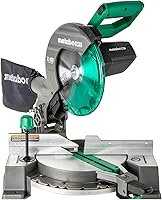
A 10-inch saw can be a practical fit for many trim and home projects. The Metabo HPT C10FCG2 is a 10-inch, single-bevel compound saw with a 0–52° miter range left and right and a 0–45° bevel range to the left.
A 12-inch blade may suit projects where you need the specific capacity of that saw. The DeWalt DWS716 has a 12-inch blade, a 0–50° miter range left and right, and bevels 0–48° to either side.
Do not use blade diameter as a substitute for checking the actual cut limits. Compare the manufacturer's capacity figures with your lumber or trim measurements, especially for angled cuts.
The Metabo HPT is a sensible candidate if you want a corded 10-inch saw, one bevel direction and a lighter body for moving between storage and a work area. Skip it if your regular work needs bevels in both directions without turning the stock, or if you need sliding capacity for wider boards.
The DWS716 suits projects that call for a 12-inch blade, dual bevel and tall fences for crown or base molding. Its 48.3 lb weight makes it a less natural choice if you expect to carry the saw often.
Do you need a sliding miter saw?
Choose a sliding model when you need to crosscut wider stock than a non-sliding saw can handle. Check capacity at the angles you plan to use, because a maximum crosscut may not apply to every cut.
A sliding saw moves the blade head forward and back through the material. That travel can increase crosscut capacity, but the rails need clearance behind the saw or a suitable stand arrangement.
The Skil MS6305-00 is a 10-inch dual-bevel sliding saw. Its stated capacity reaches 2x12 lumber at 90° and 2x8 lumber at 45°, giving you concrete limits to compare with your stock.
This Skil fits a buyer who regularly cuts wider boards and wants both sliding travel and bevels in either direction. Skip it if your work is mostly narrow trim, your bench sits close to a wall, or you do not have space for the saw's sliding movement.
If most of your cuts are on narrow trim or small boards, a sliding mechanism may add size and setup needs without helping your usual work. Our guide to sliding versus compound miter saws can help decide whether the extra travel fits your jobs.
Is a single-bevel or dual-bevel saw better?
Choose single bevel for occasional bevel cuts in one direction, or dual bevel if you often make matching bevels in both directions. Dual-bevel saws tilt left and right, which can save you from flipping the material for the opposite angle.
The Metabo HPT C10FCG2 bevels up to 45° left. It can suit work where one bevel direction is enough and the stock can be repositioned as needed.
For paired bevel cuts on opposite sides, a dual-bevel saw can make the workflow simpler. The Skil MS6305-00 has positive bevel stop positions at 48° and 45° left, 0°, and 45° right.
The DeWalt DWS716 also tilts both ways, with positive stops at 0°, 22.5°, 33.9° and 45° to the left and right. Compare the stops with the angles in your project plans, since convenient stops do not replace checking the setting before a cut.
A dual-bevel saw is useful for repeated trim or frame work where you make opposing bevels. If you rarely bevel, a single-bevel model may cover your work with fewer adjustments to manage.
For a clearer distinction between the two types of angled cuts, read our guide to miter cuts versus bevel cuts.
Which miter range and stops are useful?
Look for a miter range that covers your project angles and stops for angles you repeat often. Stops make common settings faster to reach, but the scale and lock still need to be set correctly.
The Metabo HPT has a 0–52° miter range left and right. The Skil MS6305-00 cuts up to 50° in both directions and has 11 positive stops at common angles.
The DeWalt DWS716 has a 0–50° range left and right, a stainless-steel detent plate with 14 positive stops, and a detent override. Compare the stop positions with your work rather than treating a higher count as automatically better.
Before making a matching set of cuts, check that the miter setting is locked and the stock is seated against the fence. A small change in angle can affect how two trim pieces meet, so make a scrap cut when the joint needs to fit closely.
Does the power source matter?
Choose corded power for a fixed workshop setup or cordless power when moving between work areas matters more. Match the choice to where you cut, how long you work, and whether you already use a compatible battery system.
The Metabo HPT and Skil are corded electric models. A corded saw needs a suitable outlet and a safe cord path that stays clear of the blade and your movement.
The DeWalt DCS361B is a cordless 20V MAX model. It weighs about 30 lb and works with 20V MAX batteries and chargers.
This DeWalt suits mobile jobs and smaller stock where its 7-1/4-inch blade capacity is enough. Skip it if your work regularly needs the wider capacity of a larger saw, or if you do not want to manage battery charging and runtime.
The DCS361B is a tool-only model, so account for the battery and charger needed if you do not already have compatible equipment. If you are weighing the two power setups, see our corded versus cordless miter saw guide.
What support and cut-line features help?
A clear cut line, secure clamping and good material support can help you set up cuts consistently. Check how the saw shows the blade path and holds the stock, then consider whether its table and fence support your material.
The Metabo HPT uses an Xact Cut shadow line system and includes a vice clamping system. The Skil MS6305-00 has an LED Shadow Line and a quick work clamp.
The DeWalt DCS361B has an integrated cut-line cross-cut positioning system and a machined base fence. The DWS716 has tall sliding fences that support base molding up to 6-1/2 in vertically and crown molding up to 6-5/8 in nested.
A laser or shadow line helps indicate where the blade will meet the material, but it does not replace a secure setup. Keep the stock against the fence, clamp it when appropriate, and confirm the cut on scrap before working on finished material.
For accurate work, support long stock at the same height as the saw table. Unsupported material can shift or tip during a cut, which can spoil the angle and create a safety risk.
How should you compare weight and workspace?
Measure the saw's footprint, working travel and the material you need to support. A sliding saw may need clearance behind it, while a larger table or fence can help support longer stock.
These four saws range from the 24.2 lb Metabo HPT to the 48.3 lb DeWalt DWS716. The cordless DeWalt DCS361B weighs about 30 lb, while the Skil MS6305-00 weighs 39.4 lb.
Use weight as one part of the portability decision. Check the route from storage to the work area, whether you can lift the saw safely, and whether its handle and base make it practical to move.
For a fixed bench, prioritize a stable mounting position, room to feed stock, and enough space for support stands or extensions. For a sliding model, make a full travel check before you settle on a bench location.
Measure your work area with the saw in mind, not only the machine's listed length and width. Include room for the material to extend on both sides, your stance, the saw head's travel, and a clear path for the cord if it has one.
How do you set up a miter saw for accurate cuts?
Set up the saw on a stable surface, check its alignment and secure the stock before cutting. A well-matched saw still needs a clear work area, steady support and a deliberate cut line.
Mount or place the saw so it cannot shift while you work. Set the fence square to the table according to the manual, and check the blade's angle and miter scale before making important cuts.
Support the board close to the saw and keep it flat against both the table and fence. Use the clamp when it can hold the piece securely without interfering with the blade path.
For the first cut at a new setting, use scrap from the same material if possible. Check the resulting angle and fit, then make adjustments before cutting the finished piece.
Keep hands outside the blade path and wait for the blade to stop before raising the saw head or removing offcuts. Follow the saw's manual for blade changes, guards and any model-specific setup steps.
What care helps a miter saw stay accurate?
Keep the table, fence and moving parts clean, and check key settings when the saw moves or the cuts begin to drift. Routine checks help you catch setup changes before they affect a full batch of material.
Clear sawdust from the table and fence after use, following the manual's directions for cleaning and dust collection. Keep the blade guard working freely and inspect the blade for damage or buildup before cutting.
A dull or dirty blade can leave rough cuts and make the saw work harder. Choose a blade suited to the material and finish you want, and replace it when it becomes damaged or no longer cuts cleanly.
After transporting the saw, verify the fence, bevel and miter settings before precise work. Do not assume that a setting is unchanged just because the saw was locked for carrying.
What common miter saw buying mistakes should you avoid?
The most common buying mistakes are choosing by blade size alone, overlooking clearance, and paying for features you will rarely use. Base the decision on your stock, cut angles and workspace.
- Do not buy a larger blade without checking the saw's actual crosscut capacity.
- Do not choose sliding action until you have checked rail clearance and storage space.
- Do not pay extra for dual bevel if you seldom make bevel cuts.
- Do not assume a cut-line guide or stop makes every cut accurate by itself.
- Do not overlook the weight if you move the saw between locations.
- Do not forget material support, a safe cord path or compatible batteries for a cordless tool.
A feature only earns its place if it solves a repeat problem. If a saw's key capacity or angle range does not fit the work, extra convenience features will not fix that mismatch.
Which miter saw fits your project?
Pick the saw that meets your required cut capacity and the way you work. A short decision rule is often more useful than comparing every feature in isolation.
- Choose the Metabo HPT C10FCG2 for a portable corded 10-inch saw when one bevel direction is enough.
- Choose the Skil MS6305-00 for wider stock, sliding travel and dual-bevel cuts, if your workspace has room for it.
- Choose the DeWalt DWS716 when a 12-inch blade, tall molding support and dual bevel match your work.
- Choose the DeWalt DCS361B when cordless portability matters and its smaller blade capacity suits your stock.
Skip sliding action if narrow boards and trim make up nearly all your work. Skip dual bevel if flipping or repositioning stock is easy for your projects.
If none of the listed capacities fit your material, keep comparing instead of compromising on the cut your work requires.
For standard compound cuts, compare the options in our compound miter saw guide. If you need both bevel directions or wider crosscuts, prioritize those needs and confirm each model's stated limits.
What to look for in a miter saw before you decide
For what to look for in a miter saw, start with the widest stock and the angles you cut most, then confirm capacity and workspace fit. Choose the Metabo HPT for portable, single-bevel work, the Skil for wider sliding cuts with dual bevel, the DWS716 for larger blade and molding support needs, or the cordless DCS361B for mobile jobs where its capacity is enough.
Measure your space, support the material and make a scrap cut when a setting or fit matters. If you are still deciding whether this tool fits your projects, read what a miter saw is used for.
Frequently asked questions
What should I look for first when buying a miter saw?
Start with the cuts and material you expect to handle most often. Check that the saw's blade size and cutting capacity fit your stock, then compare whether you need sliding action, one or two bevel directions, corded or cordless power, and a work support setup that fits your space.
Is a 10-inch or 12-inch miter saw better?
Neither size is automatically better; choose based on the stock and cut capacity you need. A 10-inch blade may suit common trim and smaller projects, while a 12-inch model may offer more capacity.
Compare each saw's stated cutting limits because blade size alone does not tell you what fits.
Do I need a sliding miter saw?
A sliding miter saw can help when you need to crosscut wider boards than a non-sliding saw of the same blade size can handle. Compare the saw's stated capacity at the angles you use, and consider whether the extra travel and room behind the saw fit your work area.
Should I buy a single-bevel or dual-bevel miter saw?
Choose single bevel if tilting the workpiece to make the opposite bevel is acceptable; choose dual bevel if you want the saw to tilt both ways for paired angled cuts. A dual-bevel model can reduce repositioning, but it may not matter for projects that rarely need bevel cuts.
Are laser guides necessary on a miter saw?
A laser or shadow line can help you see where the blade will meet the material, but it is only one part of accurate setup. Check how the cut line is shown, secure the workpiece, and make a cut on scrap before cutting finished material.